


Turn raw app and game state into state that Jev reads well.
Jev, TypeSafe AI's System One model, is fast and cheap, and its answers always match the types you ask for. It also has documented weak spots:
- It reads numbers as text, so it can't compare or divide them reliably.
- It can't count.
- It struggles with mixed-format and relative dates.
- Its accuracy drops as irrelevant state piles up.
jev-state handles those parts in plain code before the state reaches Jev:
import { band, count, each, pipe, project, prune, time } from "jev-state";

const { state } = project(
  gameState,
  {
    npc: {
      hp: band({ max: (ctx) => ctx.parent.maxHp, cuts: [0.2, 0.5], labels: ["critical", "low", "healthy"] }),
      ammo: count({ few: 5, many: 15 }),
    },
    enemies: pipe(
      prune({ keep: ["type", "distance"], sortBy: (a, b) => a.distance - b.distance, max: 5 }),
      each({ distance: band({ cuts: [10, 30], labels: ["near", "medium", "far"] }) }),
    ),
    lastNoiseAt: time({ now: Date.now() }),
  },
  { unknown: "drop" },
);The library never calls the API and has no runtime dependencies. Pass state to @typesafe-ai/sdk as usual.
npm install jev-stateNode.js 22+. Ships ESM, CommonJS, and TypeScript types.
npm install jev-state @typesafe-ai/sdk
export TYPESAFE_API_KEY=your-key   # from TypeSafe
Save this as quickstart.ts and run it with npx tsx quickstart.ts:
import { TypeSafeClient, choice } from "@typesafe-ai/sdk";
import { band, count, project, time } from "jev-state";

// 1. The state your app already has: exact numbers, epoch times, extra fields.
const now = Date.now();
const raw = {
  hp: 38,
  maxHp: 250,
  enemies: [{ distance: 7.9 }, { distance: 45 }],
  lastNoiseAt: now - 20_000,
  debug: { frameMs: 11.2, drawCalls: 1432 },
};

// 2. Describe it once. You choose the thresholds; jev-state applies them.
const { state } = project(
  raw,
  {
    hp: band({ max: (ctx) => ctx.parent.maxHp, cuts: [0.2, 0.5], labels: ["critical", "low", "healthy"] }),
    enemies: count(),
    lastNoiseAt: time({ now }),
  },
  { unknown: "drop" },
);
console.log(state);
// { hp: "critical", enemies: "a few", lastNoiseAt: "less than a minute ago" }

// 3. Ask Jev as usual. TypeSafeClient reads TYPESAFE_API_KEY from the environment.
const client = new TypeSafeClient();
const { answers } = await client.systemOne({
  state,
  questions: {
    action: choice("What should the NPC do next?", {
      retreat: "Health is critical and enemies are around.",
      attack: "Health is fine and enemies are around.",
      patrol: "No enemies are around.",
    }),
  },
});
console.log(answers.action.choice, answers.action.confidence);
// retreat 1
project() returns plain JSON, so state goes straight into client.systemOne().
| Your state has… | Use | Example |
|---|---|---|
| A number whose meaning depends on a range (health, price, score, distance) | band() |
hp: 38 of 250 → "critical" |
| A list or a count | count() |
[3 contacts] → "3 or more times" |
| A timestamp or date | time() |
1790678485386 → "less than a minute ago" |
| Fields the decision doesn't need (ids, positions, debug data) | prune(), drop(), or unknown: "drop" |
meshId, position → removed |
| A value computed from several fields | pipe() with your own function first |
cents + hours open → "$500 or more", "more than 24 hours" |
| A list Jev should choose from | pick() |
three tools → "refund_order", mapped back to the tool object |
You choose the thresholds; jev-state applies them the same way on every call.
Each recipe is a runnable file in examples/recipes/.
import { band, count, each, pipe, project, prune, time } from "jev-state";

const now = Date.now();
const raw = {
  npc: { hp: 90, maxHp: 500, ammo: 3, medkits: 1, meshId: "soldier_2", position: { x: 12.4, y: 0, z: -88.1 } },
  enemies: [
    { id: "e1", type: "sniper", distance: 62.4, velocity: { x: 0, z: 0.1 } },
    { id: "e2", type: "rifleman", distance: 7.9, velocity: { x: 1.2, z: -0.4 } },
  ],
  lastNoiseAt: now - 4_000,
};

const { state } = project(
  raw,
  {
    npc: {
      // A fraction of each NPC's own max health: 90 of 500 is 18%, so "critical".
      hp: band({ max: (ctx) => ctx.parent.maxHp, cuts: [0.2, 0.5], labels: ["critical", "low", "healthy"] }),
      ammo: count({ few: 5, many: 15 }),
      medkits: count(),
    },
    // Nearest first, at most five, only the fields the decision needs.
    enemies: pipe(
      prune({ keep: ["type", "distance"], sortBy: (a, b) => a.distance - b.distance, max: 5 }),
      each({ distance: band({ cuts: [10, 30], labels: ["near", "medium", "far"] }) }),
    ),
    lastNoiseAt: time({ now }),
  },
  { unknown: "drop" },
);

console.log(state);
// {
//   npc: { hp: "critical", ammo: "a few", medkits: "one" },
//   enemies: [{ type: "rifleman", distance: "near" }, { type: "sniper", distance: "far" }],
//   lastNoiseAt: "just now"
// }import { band, count, pipe, project } from "jev-state";
const HOUR = 3_600_000;
const raw = {
ticket: { id: "T-48213", createdAt: "2026-10-09T06:00:00Z", internalRef: "zd_99812" },
order: { id: "ORD-7731", totalCents: 64_900, currency: "USD", warehouse: "SFO-2" },
contacts: [{ channel: "email" }, { channel: "chat" }, { channel: "email" }],
now: "2026-10-10T12:00:00Z",
};
const { state } = project(
raw,
{
// Derived fields: a rule keyed on a name the input doesn't have adds that field.
orderTotal: pipe(
(_, ctx) => ctx.root.order.totalCents,
band({ cuts: [50_000], labels: ["under $500", "$500 or more"] }),
),
waiting: pipe(
(_, ctx) => (Date.parse(ctx.root.now) - Date.parse(ctx.root.ticket.createdAt)) / HOUR,
band({ cuts: [1, 24], labels: ["under an hour", "a few hours", "more than 24 hours"] }),
),
contacts: count({ few: 2, many: 3, labels: { none: "0 times", one: "once", few: "twice", many: "3 or more times" } }),
},
{ unknown: "drop" },
);
console.log(state);
// { contacts: "3 or more times", orderTotal: "$500 or more", waiting: "more than 24 hours" }import { pick } from "jev-state";
const tools = [
{ name: "search_docs", description: "Answer a how-to question from the product docs." },
{ name: "refund_order", description: "Refund an order that was charged twice or never arrived." },
{ name: "escalate", description: "Hand off to a human for anything legal, security, or account access." },
];
// A choice question with one option per tool, plus "none of these".
const route = pick("Which tool should handle this request?", tools, {
label: (t) => t.name,
describe: (t) => t.description,
none: "None of these tools fit; reply directly.",
});
// Send route.question to Jev:
// const { answers } = await client.systemOne({ state: request, questions: { tool: route.question } });
// then map the answer back to the original tool, or null below 60% confidence:
const answer = { choice: "refund_order", confidence: 0.93 }; // stands in for answers.tool
const tool = route.resolve(answer, { minConfidence: 0.6 });
console.log(tool?.name ?? "fallback");
// refund_orderproject() also returns meta, the paths it rewrote and removed. For the quick start above:
const { state, meta } = project(raw, schema, { unknown: "drop" });
console.log(meta.changed); // ["hp", "enemies", "lastNoiseAt"]
console.log(meta.dropped); // ["maxHp", "debug"]
If a field you need is in dropped, add it to the schema (use keep() to pass it through unchanged).
playground/ is a local web app that asks Jev the same question twice, side by side: once with raw state, once through jev-state. It covers game NPC decisions and support-ticket priority. Set the numbers yourself and watch the answers, confidence, and tokens change.
cd playground
npm install
cp .env.example .env    # add your TYPESAFE_API_KEY
npm start               # http://localhost:3000
Your key stays in the local server. See playground/README.md for details.
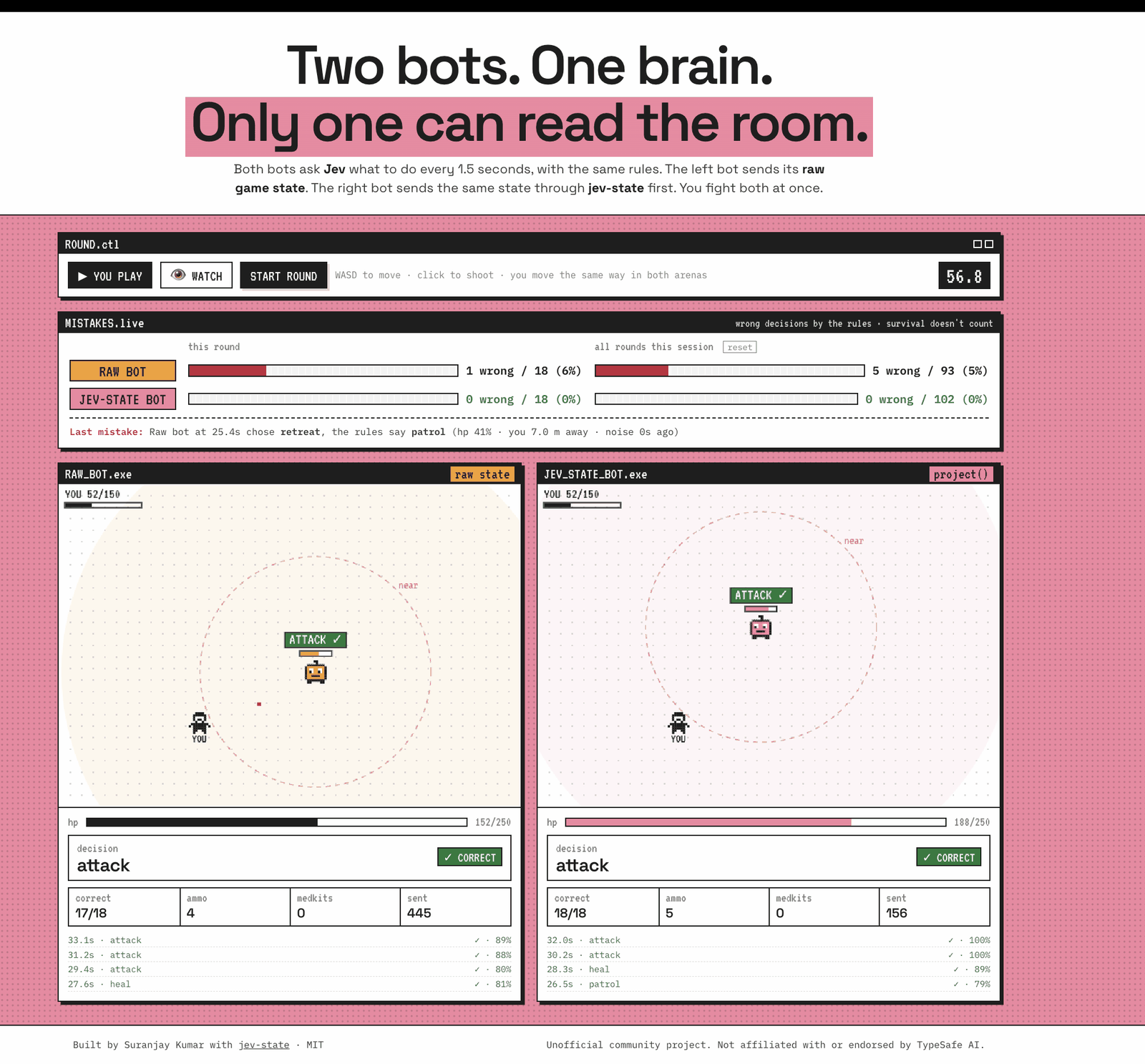
two-bots-one-brain is a small browser game built on jev-state. Two bots share one brain (Jev) and the same rules. One sends its raw game state, the other sends it through project(). You fight both at once, and a live meter counts each bot's wrong decisions by the rules.
Returns { state, meta }. meta.changed and meta.dropped list the paths that were rewritten or removed.
- A schema maps field names to rules. Nest objects to reach nested fields.
- Rules always see raw values, so
hpcan readmaxHpeven if another rule dropsmaxHp. - A rule keyed on a field the input lacks adds a derived field:
{ nearest: (_, ctx) => ... }. - The input is never mutated.
| Option | Default | |
|---|---|---|
unknown |
"keep" |
"drop" removes every field of the raw input that the schema doesn't name. Schemas inside each() and pipe() keep unnamed fields; trim those with prune(). |
dropEmpty |
true |
Removes null, "", [], and {} values. |
band({ max: 100, labels: ["low", "mid", "high"] })splitsmin..maxinto equal bands.band({ max: (ctx) => ctx.parent.maxHp, cuts: [0.2, 0.5], labels }): withmax,cutsare fractions of the range.band({ cuts: [10, 30], labels: ["near", "medium", "far"] }): withoutmax,cutsare raw values.
Returns none / one / a few / several / many. The defaults are few: 3 and many: 10.
Accepts Date objects, ISO strings, and epoch milliseconds or seconds. Returns labels like just now, a few minutes ago, within the last week or in a few minutes. now can be read from state: time({ now: (ctx) => ctx.root.clock }).
On arrays it filters, then sorts (without mutating), then caps with max, then trims each object's fields. On objects it trims fields.
drop()removes a field.keep()passes a field through whenunknownis"drop".each()maps over an array.pipe()chains rules.- Any function
(value, ctx) => newValueis a rule. ReturnDROPto remove the field.
Jev works better when asked "which of these is it?" than when asked to extract a value. pick turns a list into a choice question and maps the answer back to the original item:
import { TypeSafeClient } from "@typesafe-ai/sdk";
import { pick } from "jev-state";

const target = pick("Which enemy should be attacked first?", enemies, {
  label: (e) => e.name,                    // becomes a stable option id, e.g. "goblin_archer"
  describe: (e) => `${e.type}, ${e.distance}`,
});

const { answers } = await new TypeSafeClient().systemOne({ state, questions: { target: target.question } });
const enemy = target.resolve(answers.target, { minConfidence: 0.6 }); // the original object, or nullpickadds anone_of_theseoption by default. Reword it withnone: "Hold fire"or leave it out withnone: false.- Duplicate labels get
_2,_3suffixes. - It throws if there are fewer than 2 options or more than Jev's 255.
bench/ sends 70 seeded NPC scenarios to the real Jev API twice: once as raw state, once through jev-state. The instructions and options are the same both times. Both are graded against the rules Jev was given.
On jev-1.13.0 (2026-09-29): 420 calls, 0 errors, $0.017 total.
| Raw state | jev-state | |
|---|---|---|
| Accuracy | 74.3% | 100.0% |
| Scenarios whose answer changed across 3 reruns | 6 / 70 | 0 / 70 |
| Avg input tokens | 1,236 | 699 (−43%) |
| p50 / p95 latency | 336 / 422 ms | 335 / 390 ms |
With raw state, accuracy fell furthest on the rules that need arithmetic: retreat got 50% (compare hp to 20% of maxHp) and patrol got 43% (decide whether a noise was under a minute old). Details and per-action numbers are in bench/results.md. Every individual answer is in bench/results.json.
What this does and doesn't show. jev-state does the arithmetic in code, so the projected state already says "critical" where the raw state says hp: 38, maxHp: 250. The benchmark measures what that buys you end to end on the same instructions. It does not show that Jev reasons better in general. It also has limits: one domain, synthetic scenarios, and a policy written for this test.
One more finding: on raw state, Jev's confidence was well calibrated. Answers it rated 70–90% were right 81% of the time (average confidence 82%). That makes minConfidence thresholds a reasonable fallback signal.
Reproduce it:
cp .env.example .env    # add TYPESAFE_API_KEY
npm run bench # or: npm run bench -- --per-action 2 --reruns 1npm install
npm test # unit tests, no network
npm run typecheck
npm run build
npm run quickstart # the quick start; needs TYPESAFE_API_KEY in .env
npm run example # one NPC decision; calls Jev if TYPESAFE_API_KEY is set
npm run compare # one situation sent as raw state and as jev-state; edit the numbers in examples/compare.tsIssues and pull requests are welcome. See CONTRIBUTING.md for setup, guidelines, and roadmap ideas.
MIT © 2026 Suranjay Kumar