
Understand the impacts of additional features related to stock-out, store closing date or cannibalisation on a Machine Learning model for sales forecasting

Based on the feedback of the last Makridakis Forecasting Competitions, Machine Learning models can reduce the forecasting error by 20% to 60% compared to benchmark statistical models.
Their significant advantage is the ability to integrate external features that significantly affect sales variability.
For example, e-commerce cosmetics sales are driven by special events (promotions) and by how you advertise a reference on the website (first page, second page, …).
This process called features engineering is based on analytical concepts and business insights to understand what could drive your sales.
In this Article, we examine the impact of several features on model accuracy using the M5 Forecasting competition dataset.
Based on business insights and common sense, we will add features built on existing ones to help our model capture all the key factors affecting your customer demand.
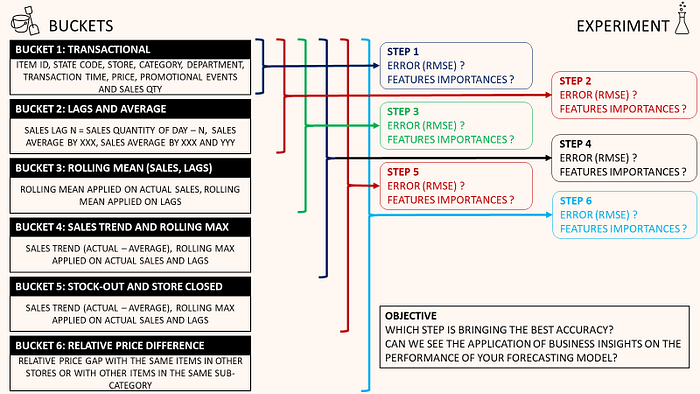
This analysis will be based on the M5 Forecasting dataset of Walmart store sales records (Link).
- Create a folder named Data in your directory where the notebook is located
- Download all the files of the Kaggle forecasting competition (Link).
- Launch the notebook
- The full write-up, with the reasoning behind the code: Machine Learning for Retail Sales Forecasting — Feature Engineering
- Test what you learned: the Supply Science App has lessons and quizzes on inventory management, free and in the browser.
- 100+ case studies with their source code: samirsaci.com
Samir Saci, supply chain engineer and data scientist with ten years in operations across Asia and Europe. Founder of LogiGreen, creator of Supply Science. For consulting on analytics and sustainable supply chain transformation: LogiGreen. More about me: samirsaci.com/about · LinkedIn