This repository contains the official implementation of our paper:
📄Frequency-Compensated Network for Daily Arctic Sea Ice Concentration Prediction, IEEE TGRS 2025
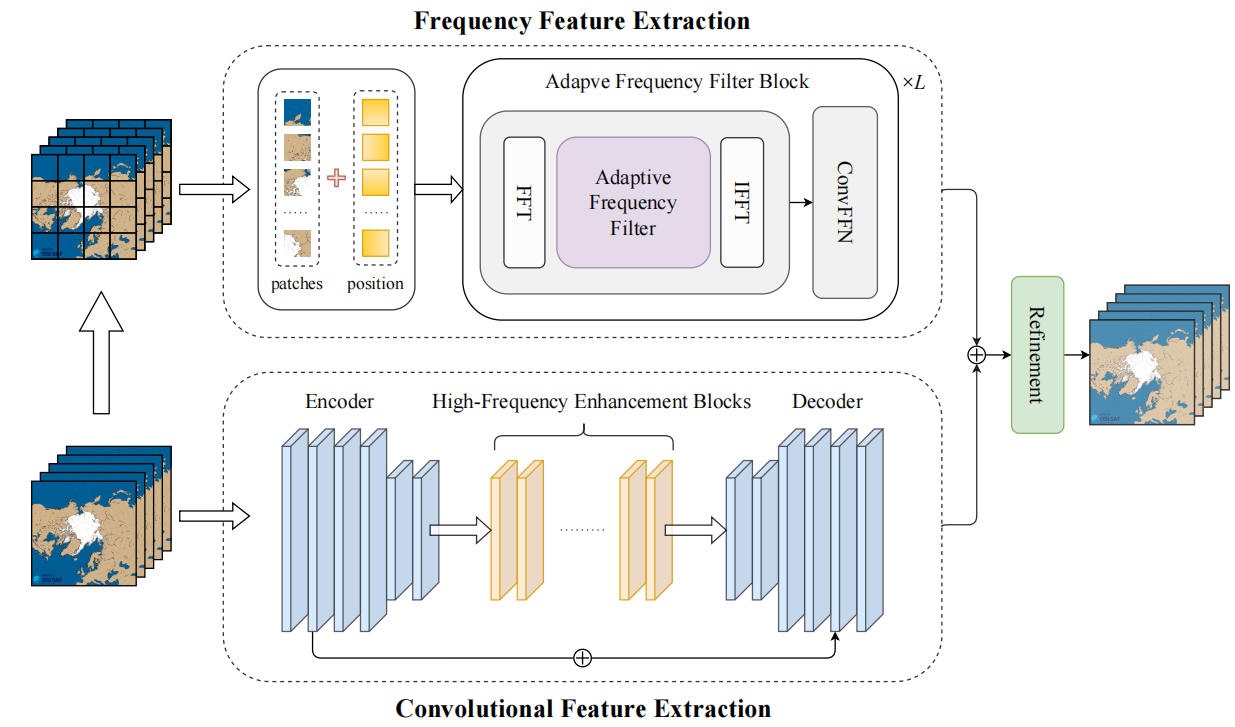
Frequency-Compensated Network (FCNet) is designed for Arctic SIC prediction. In particular, we design a dual-branch network, including branches for frequency feature extraction and convolutional feature extraction. For frequency feature extraction, we design an adaptive frequency filter block, which integrates trainable layers with Fourier-based filters. By adding frequency features, the FCNet can achieve refined prediction of edges and details. For convolutional feature extraction, we propose a high-frequency enhancement block to separate high and low-frequency information. Moreover, high-frequency features are enhanced via channel-wise attention, and temporal attention unit is employed for low-frequency feature extraction to capture long-range sea ice changes.
Run conda env create -f environment.yaml to create the Python environment.
Run conda activate arctic_sic_prediction to activate the Python environment.
We recommend following the steps below to download and organize the dataset to avoid any issues.
The daily SIC data used in this study can be downloaded from OSI SAF: https://osi-saf.eumetsat.int/products/osi-450-a and https://osi-saf.eumetsat.int/products/osi-430-a, which also contains a detailed description of the dataset and user guide.
Run the download_and_organize_data.py file in the data directory to download and reorganize the data.
The reorganized data structure should look like this:
├── 1991
├── 1992
├── 1993
......
├── 2019
│   ├── 01
│   │   ├── ice_conc_nh_ease2-250_cdr-v3p0_201901011200.nc
│   │   ├── ice_conc_nh_ease2-250_cdr-v3p0_201901021200.nc
│   │   ├── ice_conc_nh_ease2-250_cdr-v3p0_201901031200.nc
│   │   ├── ice_conc_nh_ease2-250_cdr-v3p0_201901041200.nc
......
├── 2024
bash gen_data_path.shThe generated data_path.txt file will be located in the data directory.
The content of data_path.txt should look like this:
OSI-SAF/1991/01/ice_conc_nh_ease2-250_cdr-v3p0_199101011200.nc
OSI-SAF/1991/01/ice_conc_nh_ease2-250_cdr-v3p0_199101021200.nc
OSI-SAF/1991/01/ice_conc_nh_ease2-250_cdr-v3p0_199101031200.nc
OSI-SAF/1991/01/ice_conc_nh_ease2-250_cdr-v3p0_199101041200.nc
......
Change the relevant parameters and the .nc file path in the config.py file. Place all the scripts under the same folder and run:
python train.pyThe training process will be printed, and you can also choose to direct this information to other logging files.
Specify the testing period and output directory and run:
python test.py -st 20160101 -et 20160128Alternatively, perform batch testing with:
bash test.shArgs:
parser.add_argument('-st', '--start_time', type=int,
                        required=True, help="Starting time (six digits, YYYYMMDD)")
parser.add_argument('-et', '--end_time', type=int,
required=True, help="Ending time (six digits, YYYYMMDD)")We also provide details for evaluating the model in model_result_analysis.ipynb, containing different metrics and plotting.
🔥 We hope FCNet is helpful for your work. Thanks a lot for your attention.🔥
If you have any questions, feel free to contact us via Email:
📧 Feng Gao: gaofeng@ouc.edu.cn
📧 Jialiang Zhang: zhangjia_liang@foxmail.com
We hope FCNet helps your research! ⭐ If you find our work useful, please cite:
@ARTICLE{10976656,
  author={Zhang, Jialiang and Gao, Feng and Gan, Yanhai and Dong, Junyu and Du, Qian},
  journal={IEEE Transactions on Geoscience and Remote Sensing},
  title={Frequency-Compensated Network for Daily Arctic Sea Ice Concentration Prediction},
  year={2025},
  volume={63},
  number={},
  pages={1-15},
  keywords={Sea ice;Feature extraction;Arctic;Frequency-domain analysis;Predictive models;Adaptive filters;Numerical models;Biological system modeling;Information filters;Data models;Arctic sea ice prediction;deep learning;frequency compensation;sea ice concentration (SIC);spatial-temporal attention},
  doi={10.1109/TGRS.2025.3564457}}