

The production layer for AI-built apps.
Checks across Supabase, Vercel and Stripe, and an engine that races every rule in your database on real PostgreSQL, before your users do.


Website · Engine · Connect your chat · Docs · Discord
The engine inside VibeRaven, on the bundled example:
npx -y viberaven@1.10.0 race --exampleAt most 2 bookings per event: 60 orders, 24 broken, 0 waiting; 1.495s total
read committed: 12/20 broken
repeatable read: 12/20 broken
serializable: 0/20 broken
First broken order 001101 (read committed); COMMIT A=true, B=true
Replay record is byte-identical, including PostgreSQL protocol bytes.
That is the engine inside VibeRaven: race tests your app's database with two users at once, on real PostgreSQL, without Docker, and replays exactly what broke. In order 001101, A inserts, B inserts, A commits, B commits: the event ends with 3 bookings out of 2. The bundled fix brings it to 0 broken of 60.

Add https://viberaven.dev/mcp as a custom connector in ChatGPT, Claude, Codex, Cursor or Lovable, then ask: "Can two users book the last seat?" Setup for each agent.
npx -y viberaven@1.10.0 check   # what is risky before launch
npx -y viberaven@1.10.0 race # what breaks when two users act at oncecheckreads migrations, client code and env files, and names the file and line for each gap.raceruns the rule in yourviberaven.race.json: setup, two requests and the SQL that must stay true. Spec template.- Fix, run
raceagain, and replay the reported order. Exit 0: no order broke. Exit 1: broken. Exit 2: incomplete.
race needs Node 24+ (the CLI enables JSPI). check runs on Node 20+.
| Frozen-engine check | Result |
|---|---|
| PostgreSQL isolation specs | 122/124 |
| Hidden new statement orders | 199/200, native PostgreSQL 200/200 |
| Hidden real-app interleavings | 1,500/1,500, native PostgreSQL 1,500/1,500 |
| Byte-equal replays | 80/80 |
| Leaks between sessions | 0 in 60 isolation cases |
- Your
supabase/migrationsload verbatim into a fresh, pinned PostgreSQL 18.6. - Two independent sessions run in one PGlite WebAssembly instance, with real locks.
- Bounded statement orders are enumerated and checked against your rule.
- A broken order replays byte for byte, so a fix can be confirmed.
The engine is @viberaven/sessions.
| Agent | Setup |
|---|---|
| Claude Code | npx -y viberaven@1.10.0 init --agents claude |
| Codex | npx -y viberaven@1.10.0 init --agents codex |
| Cursor | npx -y viberaven@1.10.0 init --agents cursor |
| ChatGPT, Claude, Lovable | Add https://viberaven.dev/mcp as a custom connector |
Local MCP tools: npx -y @viberaven/mcp@1.10.0. Details in the agent hub.
Building an agent that answers provider errors? The AI SDK provider-context example adds search_guides and recent_provider_changes from the hosted MCP endpoint.
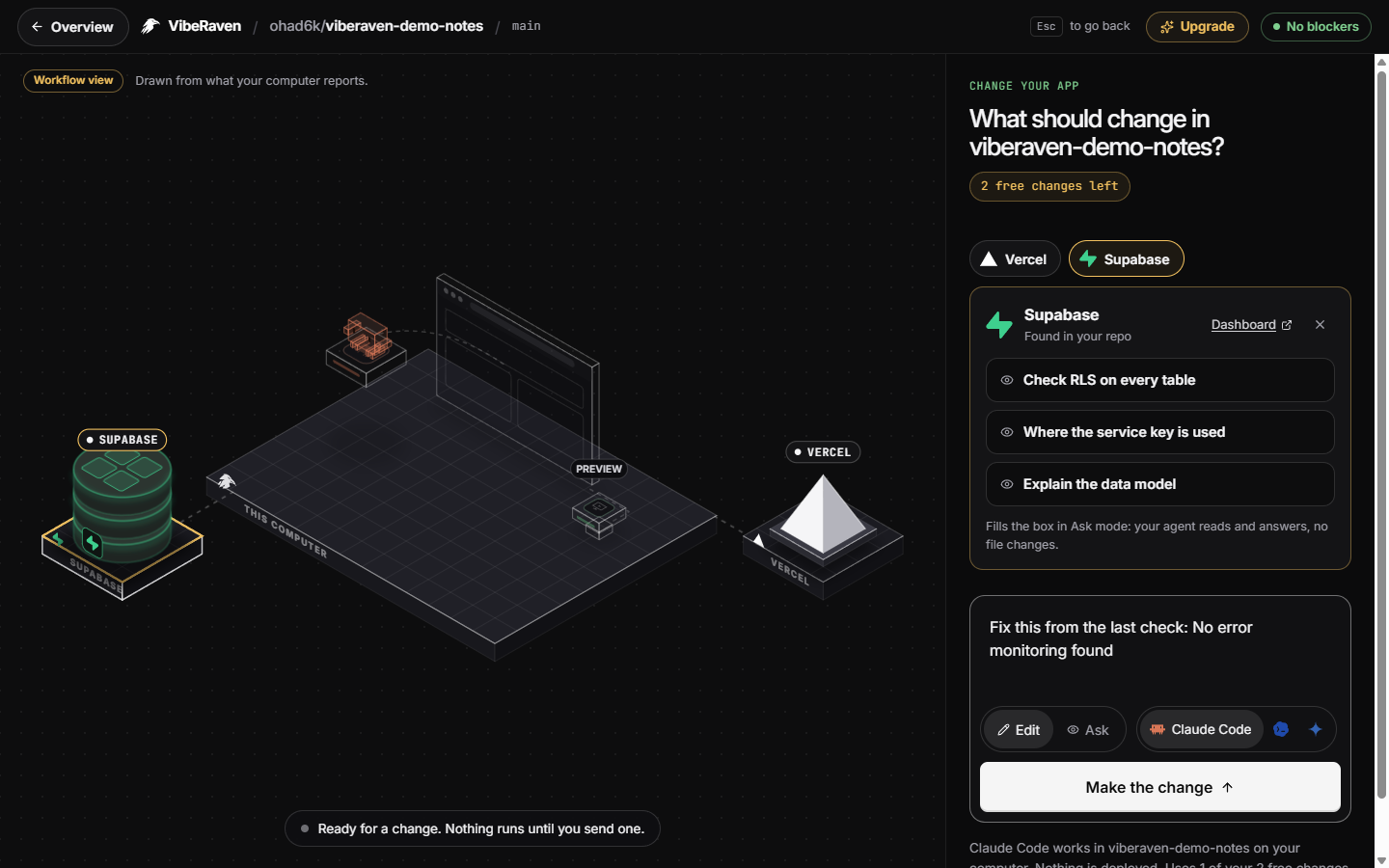
npx -y viberaven@1.10.0 opens the local Studio: chat with your coding agent, the provider board, versions and diffs, and a Race test tab that runs race and replays a broken order.
| Package | Purpose | License |
|---|---|---|
viberaven |
The npx entry |
MIT |
@viberaven/cli |
Studio, check and race |
MIT |
@viberaven/mcp |
Local repository tools over MCP stdio | MIT |
@viberaven/sessions |
Several PostgreSQL sessions in one process | Apache-2.0 |
checkreads the repository. It does not show which policies are live in Supabase or Vercel, and a clear result is not a security audit.racecovers the SQL, inputs and bounded statement orders you supply. Rules beyond a simple count limit need an explicit spec. Omitted roles run aspostgres.- An incomplete run is not a pass. Replay needs the same migrations, spec, options and runtime.
- Cloud Auth, HTTP and external I/O are outside the test. Run only SQL you trust; the engine is not a security sandbox.
- No universal PostgreSQL compatibility, and no advantage over a plain coding agent in bug finding, is claimed.
CLI and MCP: MIT. @viberaven/sessions: Apache-2.0, with PostgreSQL and third-party notices. Contributing · Security · Changelog