


Pebble HF is an experimental QRP radio designed to get more people into HF radio with a General class amateur radio license and outdoor radio operation. It is an ultra-inexpensive 20-meter single-band transceiver built for accessibility and simplicity.
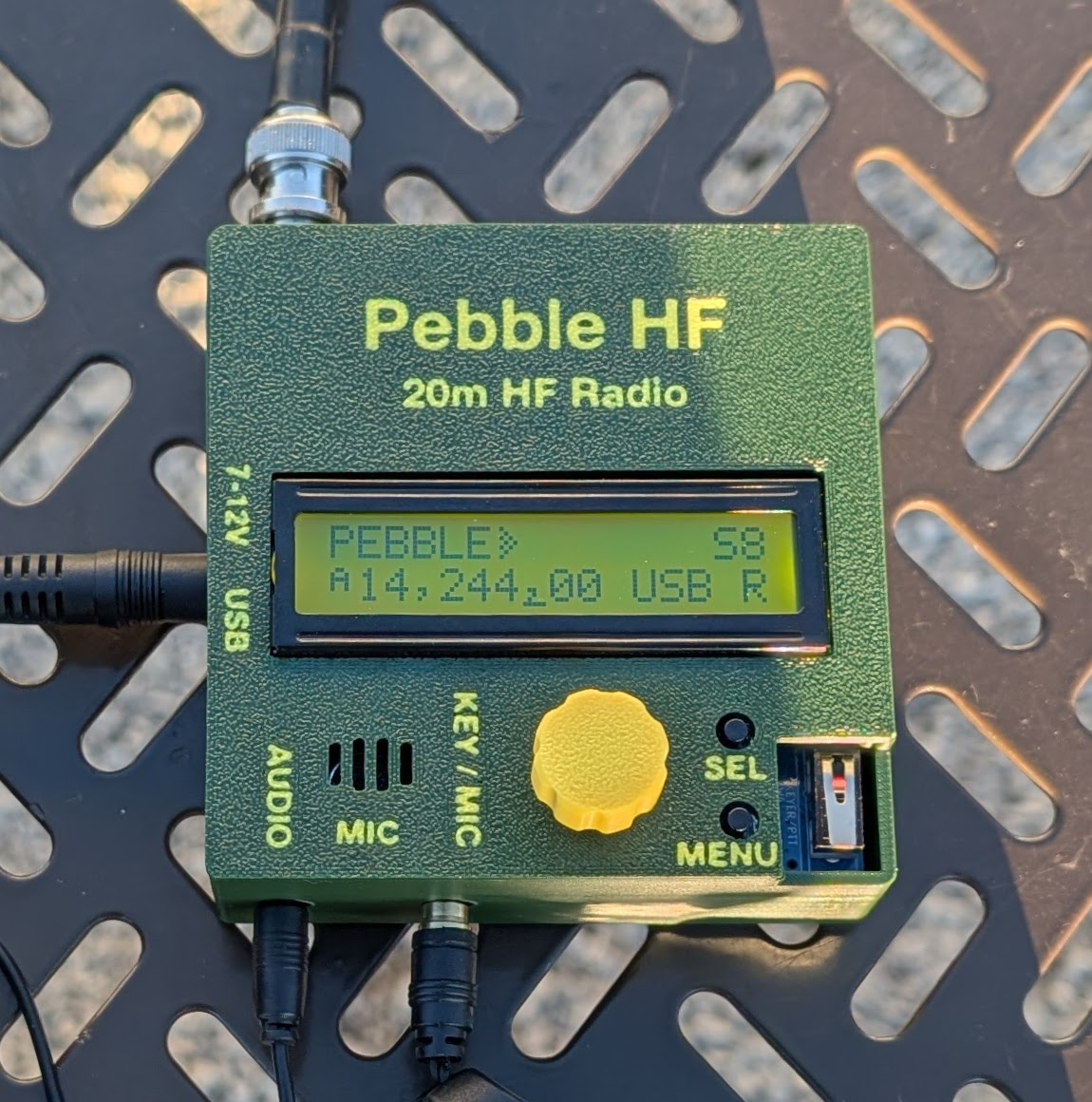
This project is built on the shoulders of giants from the open source uSDX project:
- Hardware Design: Barbaros Asuroglu, WB2CBA
- Pebble HF Firmware & Project: Mike N4FFF
- Original uSDX Firmware: Guido PE1NNZ (pe1nnz@qsl.net)
The Pebble HF firmware is a modified version of the uSDX firmware, optimized for the Pebble HF hardware platform.
Amateur radio is a fantastic hobby for learning, connection, and adventure — and small, portable radios are perfect for getting on HF, connecting with people around the world, and outdoor radio adventures like POTA and SOTA.
Pebble HF was purpose-designed to be ultra-affordable and easy to build. It is a single-band 20-meter QRP transceiver that supports CW (morse code), SSB voice (USB/LSB), and digital modes such as FT8, JS8, and FT4. The hardware was designed from the ground up by Barb WB2CBA with cost and kit-friendliness in mind — nearly all parts are pre-soldered surface mount, leaving only 14 easy through-hole parts for the builder. Most people complete the build in under an hour.
Despite its simplicity, Pebble HF is a capable software-defined radio. Both the transmitter and receiver run on a single ATMEGA328P microcontroller. The transmitter uses an efficient Class-E power amplifier driven entirely by digital signal processing, and the receiver implements DSP filtering, AGC, noise reduction, and more — all in software. This keeps the parts count low, the design simple, and the radio highly power-efficient.
- ~5W output on 7–14V battery power, ~1W on USB-C (5V) — get on the air even without a dedicated battery
- Weighs less than 4.7 oz (132g) — perfect for portable operation
- Built-in CW key and microphone — nothing extra needed to start making contacts
- Open source hardware and firmware — hack it, improve it, share it
Our mission is simple: get more people into HF ham radio and outdoor radio!
- Simple, fun and versatile QRP SSB HF transceiver with embedded DSP and SDR functions
- 20-meter single-band operation (14.000 - 14.350 MHz)
- EER Class-E driven SSB transmit-stage
- Approximately 5W PEP SSB output from 13.8V supply
- Mode support: USB, LSB, CW
- DSP filters: Full, 3000, 2400, 1800, 500, 200, 100, 50 Hz passband
- DSP features: Automatic Gain Control (AGC), Noise-reduction (NR), Voice-triggered Xmit (VOX), RX Attenuators (ATT), TX noise gate, TX drive control, Volume control, dBm/S-meter
- SSB opposite side-band/carrier suppression Transmit: better than -45dBc, IMD3 (two-tone) -33dBc, Receive: better than -50dBc
- Open source firmware, built with Arduino IDE; allows experimentation, new features can be added, contributions can be shared via Github, software-complexity: 2000 lines of code
- Software-based VOX that can be used as fast Full Break-In (QSK and semi-QSK operation) or assist in RX/TX switching for operating digital modes (no CAT or PTT interface required), external PTT output/PA control with TX-delay
- Lightweight and low-cost transceiver design: because of the EER-transmitter class-E stage it is highly power-efficient (no bulky heatsinks required), and has a simple design (no complex balanced linear power amplifier required)
- Fully digital and software-based SSB transmit-stage: samples microphone-input and reconstruct a SSB-signal by controlling the phase of the SI5351 PLL (through tiny frequency changes over 800kbits/s I2C) and the amplitude of the PA (through PWM of the PA key-shaping circuit)
- Fully digital and software-based SDR receiver-stages (optionally): samples I/Q (complex) signal from Quadrature Sampling Detector digital mixer, and performs a 90-degree phase-shift mathematically in software (Hilbert-transform) and cancels out one side-band by adding them
- CW decoder, Straight/Iambic-A/B keyer
- VFO A/B + RIT, and corresponding relay band-filter switching via I2C
- Probably the most cost effective and easy to build standalone SDR/SSB transceiver that you can find. Very much simplified circuit and versatile in use.
The Pebble HF hardware is designed by Barbaros Asuroglu, WB2CBA. For hardware schematics, bill of materials, and build information, see Barb's hardware repository on GitHub. For general project information, visit pebblehf.com.
This project is based on the original uSDX design. For other uSDX hardware variants, see the uSDX Forum.
Pebble HF has three controls: a tuning knob (rotary encoder), a MENU button (left), and a SELECT button (right).
- Tune: Turn the encoder to change frequency (locked to 14.000–14.350 MHz).
- Volume: Press and hold the encoder while turning. Turning below 0 powers off the radio.
- Step size: Short press encoder to increase, long press to decrease.
- Filter: Double-click SELECT (right) to cycle through DSP filter bandwidths.
- VFO/RIT: Long press SELECT (right) to toggle RIT, then again to swap VFO A/B.
- Menu: Short press MENU (left) to enter. Turn encoder to browse, press MENU to edit a value, press SELECT to save/exit.
- Factory reset: Hold encoder button during power-up.
Pebble HF has a built-in straight key and microphone. An external key or mic can be connected to the key/mic jack. Plugging something into the jack disables the built-in mic. Always have a paddle plugged in when using Iambic A/B keyer mode — otherwise the onboard mic may falsely trigger the keyer.
For the full operating manual including all menu options, see OPERATING_MANUAL.md.
The radio comes pre-programmed. If you need to update the firmware, see the dedicated programming guide:
For full firmware update instructions — including the easy web-based updater and the command-line (avrdude) method — see PROGRAMMING.md.
| Version | Changes |
|---|---|
| 1.0.7 | Fix critical CW RX bug from 1.0.3 — wanted signal was placed on the rejected-image side, making strong signals weak/inaudible while a loud image appeared ~1.2 kHz above. Reverted CW RX/TX oscillator config to the proven original; configurable CW tone retained |
| 1.0.6 | Fix audible "thump" between CW dits/dahs caused by sudden RX audio onset — RX audio now fades in briefly after each CW TX→RX transition (no change to RF envelope or sidetone) |
| 1.0.5 | Noise Gate setting now only applies in VOX mode; voice PTT uses optimal low threshold automatically |
| 1.0.4 | Fix VOX spurious TX from sound card DC bias on Tip/DIT pin — skip hardware PTT check when VOX is enabled |
| 1.0.3 | Fix CW sidetone offset direction — changing sidetone frequency now shifts received pitch in the same direction |
| 1.0.2 | Add configurable CW tone menu option (300–900 Hz), encoder startup cleanup |
| 1.0.1 | Decouple EEPROM version ID from firmware version string, menu version label update |
| 1.0.0 | Fork from upstream uSDX 1.02x — new versioning scheme, version display with compile date |
This project is licensed under the MIT License. See LICENSE for details.
Pebble HF Project: Mike N4FFF - Firmware modifications and project maintenance
Original uSDX Project: The uSDX was originally announced in the QRPLabs Forum as a SSB modification for a QCX. The uSDX transmitter and receiver stage both running on a ATMEGA328P, including its multiband front-end and direct PA biasing/envelope-generation technique; its concept, circuit, code are a design by Guido (PE1NNZ); the software-based SSB transmit stage is a derivate of earlier experiments with a digital SSB generation technique on a Raspberry Pi.
Hardware Design: Barbaros Asuroglu (WB2CBA) - Pebble HF hardware design
Many thanks to all contributors to the open source uSDX project, without whose work the Pebble HF would not be possible.