
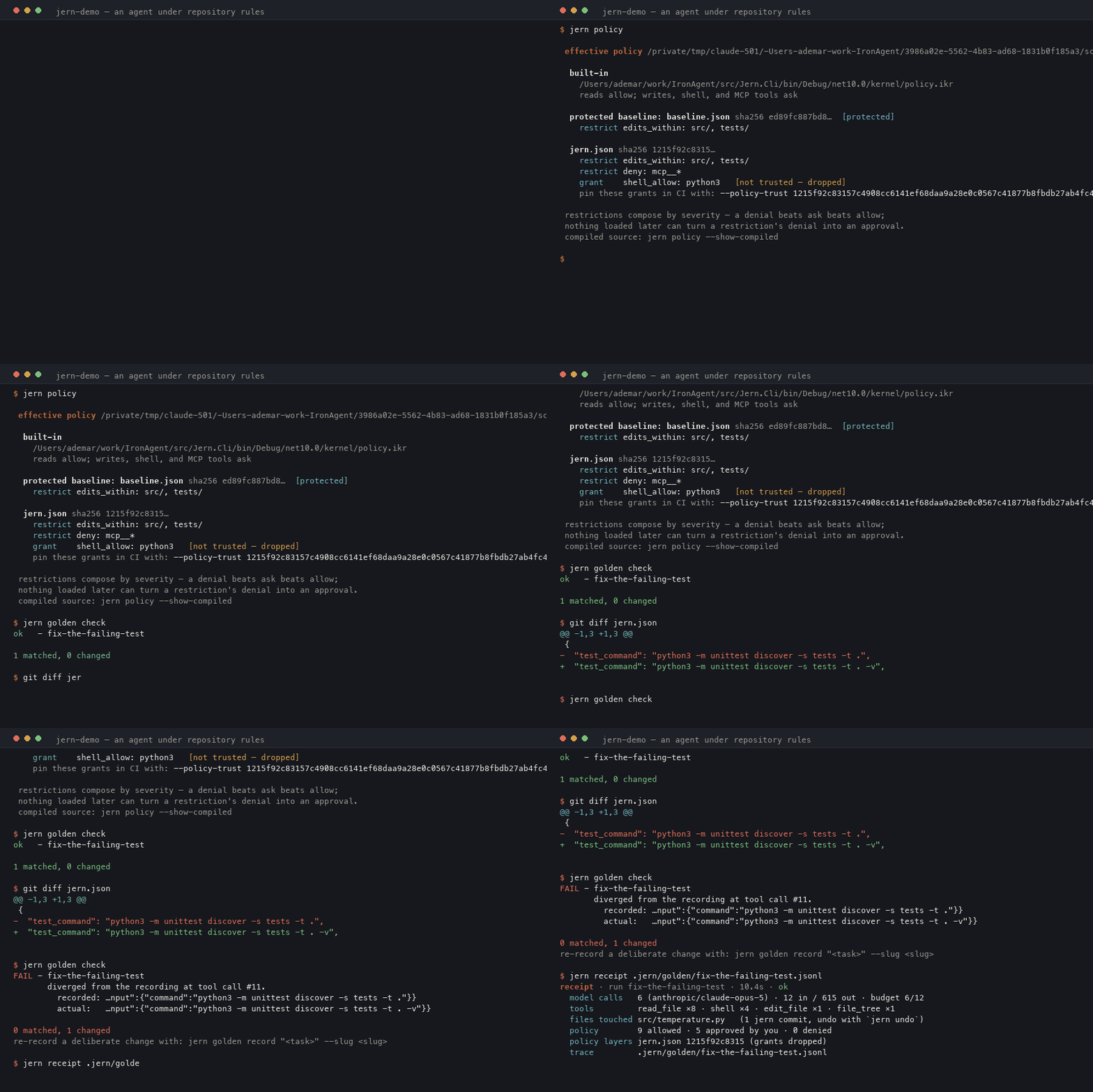
Real output from this repository — offline, no model called.
A deliberately small Python project that shows what
jern adds to a coding agent: rules the repository
enforces, a receipt for every run, and a CI gate that catches
behavior changes. There is no Lisp anywhere in this repository — the whole
setup is one jern.json, one baseline, and one workflow.
| File | What it does |
|---|---|
jern.json |
The repo's rules: the agent may only edit src/ and tests/, may run python3 without asking, may not touch MCP tools, and gets at most 12 model calls. |
.jern/baseline.json |
The protected rules. CI reads this from the base commit, so a pull request cannot weaken it by editing its own copy. |
.jern/golden/ |
A recorded session — a real run of "fix the failing test", kept as a committed snapshot of how the agent handles it. |
.github/workflows/jern.yml |
Replays that snapshot on every pull request. Offline: no API key, no model calls. |
CONVENTIONS.md |
Project conventions. jern puts this in the agent's system prompt — which is why editing it changes agent behavior, and why CI notices. |
Both are open pull requests in this repository:
-
#3 — changing the agent's configuration turns the check red. It switches the test runner in
jern.json. The agent would now run a different command, so the check fails with the exact difference:diverged from the recording at tool call #11. recorded: …"command":"python3 -m unittest discover -s tests -t ."}} actual: …"command":"python3 -m unittest discover -s tests -t . -v"}}No model was called to find that out.
-
#2 — a pull request cannot weaken the rules that judge it. It widens
edits_withinin its ownjern.jsonand deletes the protected baseline. The check's comment still shows the baseline, read from the base commit, in force. Nothing about the agent's behavior changed, so the check itself is green — the point is in the policy provenance, not the verdict.
Every run also leaves a receipt: model calls against budget, tools used, files actually written, policy decisions, and the trace they came from.
It re-executes the agent against the recording's model and tool results.
So it catches changes to the agent, its configuration, and the policy — and
it does not catch a change to a file the agent reads during the run.
Editing CONVENTIONS.md changes what a live run would
see, but the replay still answers that read_file from the recording.
Re-record to capture it. (We learned this the honest way: the first version
of this demo claimed otherwise, and the pull request went green.)
curl -fsSL https://jern.ai/install.sh | sh     # or: JERN_VERSION=0.14.4 …
jern policy          # every rule in force, and where each came from
jern golden check    # replay the recording — offline, no API key
jern golden list
To see the agent actually work (this one needs a provider key):
export ANTHROPIC_API_KEY=…     # or OPENAI_API_KEY, or none for ollama
jern run "make fahrenheit_to_celsius round to one decimal place"
It will ask before writing, refuse to touch anything outside src/ and
tests/, run the test suite after each edit, and print a receipt at the end.
A golden session protects the behavior it captured — it is a snapshot, not a
proof. Re-recording is a legitimate way to approve new behavior, so a PR that
changes recordings is reporting a change, not proving it safe; that is why
.github/CODEOWNERS puts .jern/golden/ and the
baseline behind review. The honest fine print is in jern's
security model.