Repository navigation
Call to arms: let's make OmaMobile a real alternative to Android, together (with a proposed roadmap) #867
Description

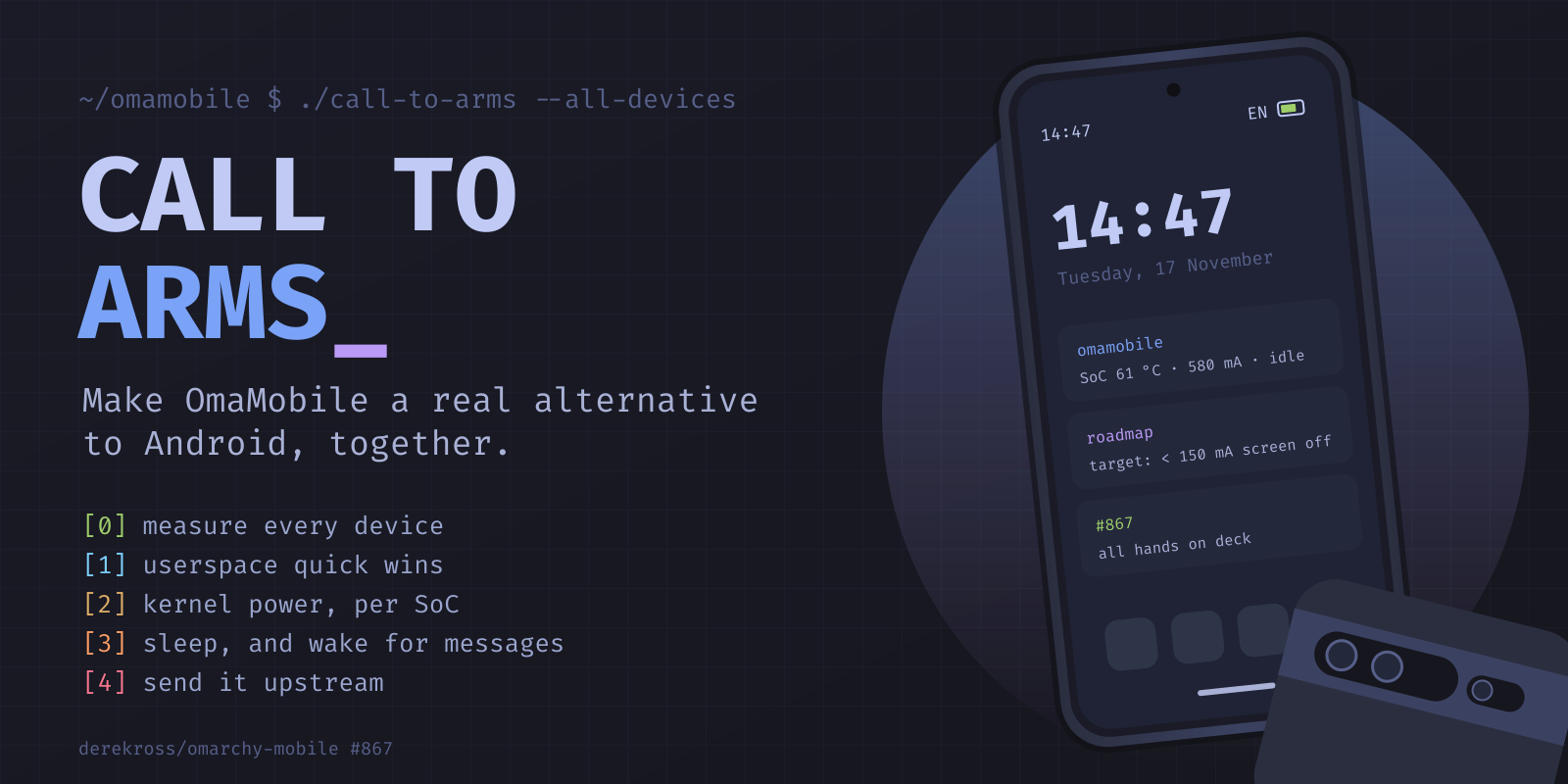
First, I'm really sorry for pinging so many people at once and bothering everyone with a long post, but this is serious and I don't think it can wait any longer, we need to get organized.
This is a call to arms for everyone porting OmaMobile to a phone. Booting Omarchy on a phone is a real achievement, but it isn't enough. If OmaMobile wants to be a real alternative to stock Android, the way Omarchy is now an alternative to macOS on Apple Silicon, our phones have to run cool, last the day and be ready when they're picked up. Right now they don't, and none of us can fix that alone on one device.
I'm not going to keep this short. Below is what I measured, where I think we stand next to Android layer by layer, a ten minute measurement recipe every device team can run, and a proposed roadmap in phases. Every target in it is a proposal to argue about, not a decision.
Android phones don't get there by luck. Each vendor ships code tuned for its own CPU and GPU and what that silicon can do: short bursts of speed for a specific job, then straight back down, apps that aren't needed kept at bay (some in RAM, some cached), priority for what matters right now like the screen, and the phone waking up every so often to pick up notifications and show them in one go. The rest of the time it runs on the bare minimum, so the battery lasts.
We don't have that as a whole yet. There's good work in pieces, the power profiles in #803, @den-kloot's battery saver in #778, the suspend runbooks, the thermal work on the 9a, but no shared plan for how software meets hardware on these phones.
Where we are today
My Pixel 8 Pro (husky), each number with its conditions:
- One reading on 11-17 at 13:47, screen off: 61 °C on the SoC, CPU 97 % idle, about 580 mA going out. That's a single reading on a warm phone, not a standing number.
- The standing number is lower but not good: a 10 minute log on battery only, screen off, nothing running, gave a steady median of 515 mA (Pixel 8 Pro idle power: steady 515 mA with the screen off (10 minute log, data inside) linux-omamobile#217), and later battery-only runs sat at 520-540 mA. The gauge isn't calibrated, so the absolute values are rough.
- Pausing the shell, the dictation overlay, voxtype and my recorder together took away about two thirds of the context switches and the median current didn't move (Power profiles for omamobile with a Doze-like policy, and what each profile changes per device (follows #778) #803). Wi-Fi power save was the one userspace change that helped, about 30 mA.
- The kernel has no CPU idle states (
current_driverreadsnone), no memory bus scaling, an emptypm_genpdandclk_ignore_unused pd_ignore_unusedon the command line. So with the screen off, that floor is the kernel and not the apps. - Screen on, a text editor and a Bluetooth keyboard, mostly idle: 71-73 °C. That's where my own thermal guard starts capping the CPU (its first trip is 72 °C, stock's device tree has 80 °C), so the guard is holding it there.
- In that same session quickshell was around 45 % CPU and Hyprland around 40 %. Both draw on the GPU through panthor, I checked, so it isn't software rendering. On 11-14 the same shell used about 3 % with the screen off. Why they burn that much with the screen on I don't know yet. Constant redraws, blur and 120 Hz are the candidates, and none of them is measured.
A second 8 Pro shows the same picture: @gitColinX read 55-56 °C on all four zones with the screen off on the charger, battery at 22 °C, and a median of 570 mA over a night with the cable out (both on #803). His unit has no cpuidle driver either.
The 9a has its own walls, and they're separate problems from my idle floor:
- Pixel 9a: a full CPU load reaches the 105 °C critical trip in ~8 s and powers the phone off (big zone rises faster than step_wise throttles) #605 (@den-kloot): a full CPU load took the zones from about 55 °C to the 105 °C critical trip in roughly 8 s and the kernel powered the phone off, twice in one morning. The zones do poll (250 ms passive, 1000 ms before a trip is crossed), but the big zone follows the big core within about 100 ms and
step_wisemoves one state per poll.power_allocatorcan't bind on the 9a because its CPUs get no energy model. - Pixel 9a, a kernel without idle states: a sleep over three minutes ends with systemd's watchdog killing journald and logind, and the lock screen stops working #765 (@W4HO-ham): without idle states the monotonic clock runs through s2idle, so any sleep past three minutes ends with systemd's watchdog killing journald and logind. I got the same on the 8 Pro with a 270 s sleep, and there it also left NetworkManager with every device unmanaged. The 9a has a stopgap merged in omamobile-device-tegu 0.2.21: no service watchdogs, a 9a sleep runs with the kernel's clock ticking (#765) #766. The real fix is idle states.
Running warm like this all the time isn't just uncomfortable in the hand or on the desk. Over months it's a risk for the battery first, and I wouldn't bet on it being kind to the adhesive or the chips either. I haven't measured any wear, I just don't want to find out the hard way.
Android and us, layer by layer
The stock Android side here is as far as I know, from Google's device trees and power model and from what's been quoted in our issues. I haven't measured a stock phone. Corrections are welcome.
- CPU idle: stock, as far as I know, drops cores into deep idle states between jobs. Ours: no cpuidle driver on the 8 Pro or on the 9a's published kernel, so a core that has nothing to do sits in WFI.
- CPU frequency: stock, as far as I know, uses vendor-tuned scheduling with short boosts. Ours: plain schedutil on all three clusters, no tuning yet.
- Memory and bus scaling (devfreq): stock scales them with load, as far as I know. Ours: no MIF/INT devfreq on the 8 Pro, and 120 Hz raises the MIF floor to 1352 MHz.
- Power domains and clocks: stock turns off what isn't used, as far as I know. Ours: nothing is turned off, and we boot telling the kernel to leave unused clocks and domains on.
- Thermal: stock, as far as I know, throttles from a skin temperature of 37-39 °C and uses
power_allocator. Ours:step_wiseon the CPU and GPU zones with trips at 80/95/105 °C, no skin zone on the 8 Pro, and hand-made guards on both phones. - Display: stock, as far as I know, drops the refresh rate when nothing moves. Ours: 120 Hz is the preferred mode on the 8 Pro and the panel never drops.
- Compositor and shell: stock's are built for a phone. Ours are a desktop compositor and shell that were never asked to sit still on a battery, and it shows in the 40-45 % above.
- Background apps: stock has Doze and app standby. Ours: @den-kloot's freeze service runs on his 9a (Quick settings: Performance / Normal / Battery saver mode that also freezes, then closes, apps left in the background #778) and the profiles in Power profiles for omamobile with a Doze-like policy, and what each profile changes per device (follows #778) #803 are a proposal.
- Suspend and notifications: stock, as far as I know, suspends and wakes in batches. Ours: first attended s2idle sleeps on the 8 Pro and 9a, a watchdog stopgap, and no plan yet for waking on a message.
- Idle current, screen off and awake: Google's own power model puts a stock 8 Pro at about 77 mA (a model, not a measurement). Ours: 515-580 mA.
A ten minute recipe for every device
We can't plan from two phones. If every device team runs the same few commands, we get one comparable baseline per device. Over ssh, any shell, nothing is changed on the phone.
Part A, any time, takes a minute. It prints the kernel, the idle driver and states, the frequency governors, devfreq, the thermal zones with their trips, the cooling devices and Wi-Fi power save:
uname -r; tr -d '\0' < /proc/device-tree/model; echo
tr ' ' '\n' < /proc/cmdline | grep -E 'ignore_unused|mem_sleep'
cat /sys/power/mem_sleep
echo "cpuidle driver: $(cat /sys/devices/system/cpu/cpuidle/current_driver 2>/dev/null)"
grep . /sys/devices/system/cpu/cpu0/cpuidle/state*/name /sys/devices/system/cpu/cpu0/cpuidle/state*/usage 2>/dev/null || echo "cpu0 has no idle states"
grep . /sys/devices/system/cpu/cpufreq/policy*/scaling_governor /sys/devices/system/cpu/cpufreq/policy*/scaling_max_freq
ls /sys/class/devfreq/
grep . /sys/class/devfreq/*/governor /sys/class/devfreq/*/cur_freq 2>/dev/null
for z in /sys/class/thermal/thermal_zone*; do
  echo "$(cat $z/type) temp=$(cat $z/temp) policy=$(cat $z/policy)"
  grep . $z/trip_point_*_type $z/trip_point_*_temp 2>/dev/null
done
grep . /sys/class/thermal/cooling_device*/type
for i in $(iw dev | awk '$1=="Interface"{print $2}'); do echo "$i: $(iw dev $i get power_save)"; done
sudo head -40 /sys/kernel/debug/pm_genpd/pm_genpd_summary
Part B, the screen-off floor. Cable out, ssh over Wi-Fi, screen off, nothing else running. Start it inside tmux or with nohup so a dropped connection doesn't end it. It waits 10 minutes, then logs the gauge and every thermal zone every 15 s for 3 minutes:
for d in /sys/class/power_supply/*; do [ "$(cat $d/type)" = Battery ] && B=$d; done
echo "gauge: $B"; sleep 600
for i in $(seq 12); do
  echo "$(date +%T) $(cat $B/status) $(cat $B/current_now) uA batt=$(cat $B/temp) zones: $(cat /sys/class/thermal/thermal_zone*/temp | tr '\n' ' ')"
  sleep 15
done | tee floor.txt
current_now is in µA and its sign depends on the gauge, the battery temperature is in tenths of a degree and the zones in thousandths. The number to report is the median current, and the status column should say Discharging.
Part C, who is awake, one minute, still screen off:
a=$(awk '/^intr/{print $2}' /proc/stat); c=$(awk '/^ctxt/{print $2}' /proc/stat); sleep 60
echo "$(( ($(awk '/^intr/{print $2}' /proc/stat) - a) / 60 )) interrupts/s, $(( ($(awk '/^ctxt/{print $2}' /proc/stat) - c) / 60 )) context switches/s"
top -b -w 200 -d 30 -n 2 -o %CPU | awk '/^top -/{n++} n==2' | head -15
sudo sort -k3 -nr /sys/kernel/debug/wakeup_sources | head -15
command -v powertop >/dev/null && sudo powertop --time=60 --csv=powertop.csv
How to post it: one issue per device, titled "Power baseline: ()", with the three outputs pasted in a <details> block. Add the conditions next to them: kernel and device package version, battery only or cable in, Wi-Fi power save on or off, room temperature if known, and whether the gauge is calibrated. If a command prints nothing or fails, post that too. A missing cpuidle directory is a result.
Proposed roadmap
Everything here is a proposal, the order and the numbers included. The targets are there so we can tell "done" from "feels better", and I expect them to change once more devices report in.
Phase 0: measure and share
Goal: one comparable baseline per device, so we know which problems are shared and which belong to one SoC.
- The recipe above lands in the repo as a doc and a small script.
- One tracking issue per device with its baseline, and a line in the device table pointing to it.
- A second run after every kernel or package change that claims a power win.
Done when (proposal): every device with an active tester has a posted baseline from the published kernel.
Phase 1: userspace quick wins
Goal: a phone with the screen on and nothing moving should cost little more than the same phone with the screen off. None of this needs a new kernel, and it's also where we overlap most with Omarchy itself.
- 60 Hz as the default on phones, with 120 Hz as a choice in Settings.
- Animations, blur and shadows: measure each one, then pick phone defaults.
- A redraw audit of the shell: find what repaints when nothing changes (clocks, timers, polling widgets, infinite animations) and stop it.
- Wakeup batching: widgets and scripts that poll every second move to events or to longer, aligned timers.
- Power profiles that do something per device, and a Doze-like policy for background apps (Power profiles for omamobile with a Doze-like policy, and what each profile changes per device (follows #778) #803, Quick settings: Performance / Normal / Battery saver mode that also freezes, then closes, apps left in the background #778).
- Wi-Fi power save on by default where it's been tested (omamobile-device-husky 0.1.15: Wi-Fi power save on by default #836 for the 8 Pro).
Done when (proposal): with a static screen for 10 minutes, the shell and the compositor are each under 5 % CPU, and the current and SoC temperature settle within about 100 mA and 5 °C of that device's own screen-off floor at the same brightness.
Phase 2: the kernel, per SoC
Goal: an awake phone that's doing nothing actually idles. This is the big one for the floor, and it's per SoC family, so it needs owners.
- cpuidle: PSCI idle states that are safe to enter. On zuma the C2 and power-domain overlays reboot-looped for me, so this needs care and a way back.
- devfreq for the memory and interconnect buses.
- Power domains and runtime PM, so we can boot without
clk_ignore_unusedandpd_ignore_unused. - Thermal zones done properly: an energy model on every SoC so
power_allocatorcan bind, a first reaction fast enough for the big cores (Pixel 9a: a full CPU load reaches the 105 °C critical trip in ~8 s and powers the phone off (big zone rises faster than step_wise throttles) #605), and a skin zone where the hardware has the sensor. - Storage and radios: UFS clock gating and link hibernation, Wi-Fi and Bluetooth runtime PM.
Done when (proposal): current_driver isn't none and the idle states count up, the screen-off awake current on battery after 10 minutes is under 150 mA, the SoC sits within about 10 °C of the battery with the screen off, and a 10 minute all-core load stays under 95 °C without any userspace guard.
Phase 3: suspend, and waking for notifications
Goal: the phone sleeps when it's in a pocket and still gets its messages.
- s2idle versus deep per SoC, decided and written down (the gs201 notes say deep doesn't wake there).
- The clock stops during sleep, so the watchdog stopgap from Pixel 9a, a kernel without idle states: a sleep over three minutes ends with systemd's watchdog killing journald and logind, and the lock screen stops working #765 can go.
- Wake sources that work every time: power key, RTC, modem (call and text), and Wi-Fi if the chip can do it.
- Batched sync: the phone wakes on a schedule, lets apps fetch, shows what came in and goes back to sleep. The Doze work from Phase 1 is the base for this.
- Find what draws current when the phone is powered off. On my 8 Pro that's about 25 mA, and sleep can't get under it.
Done when (proposal): 8 hours screen off on battery with Wi-Fi connected costs under 10 %, a 30 minute sleep ends with no service killed, each wake source works 20 times out of 20, and a message shows up within 5 minutes of being sent.
Phase 4: send it where it belongs
Goal: nothing that could live upstream stays a private patch in a device package.
- To Omarchy upstream: defaults that hurt on battery (omarchy-settings ships a NetworkManager file that turns Wi-Fi power save off), anything in the shell and the Hyprland config that redraws or polls when nothing changes, and the sleep and lock scripts that fail after a resume. A laptop on battery gains from the same fixes.
- Also to Omarchy upstream, a concrete one: its idle service keeps the timeout its idle monitor was created with, so a new
idle.lockin shell.json only takes effect after the shell restarts. On my 8 Pro, 30 s set from Settings never locked, and after a shell restart it locked 30 s later. OmaMobile works around it in omamobile-settings: lock screen timeout, and lock after 30 minutes while a keyboard is connected #866 by switching idle off and on throughomarchy-shell idle disable/enable, but I think the real fix belongs in Omarchy's idle service. - To the mainline kernel: idle states, devfreq, power domains and thermal zones for each SoC, and drivers like the max77759 charger work, sent to the lists with sign-offs once they're stable in our tree.
- Staying in OmaMobile: the per-device profile helpers, the Doze-like service, the Settings pages and each device's defaults.
Done when (proposal): every item from Phases 1 to 3 has a home written next to it (Omarchy, mainline or OmaMobile) and a link to where it was sent.
How we organize
- One tracking issue per device, opened by whoever has the phone, holding the baseline and what's open.
- One shared recipe, so every number can be compared with every other.
- An owner per layer, not per device: kernel power per SoC family, thermal, suspend and wake, shell and compositor, background apps and profiles, upstream contact. An owner doesn't do all the work, they know what's in flight.
- A direct channel and a regular call. Issue threads are good for results and bad for deciding things.
@derekross @greenbrettmichael and anyone else who runs the project: could we find a way to talk as a team, something more direct than issue threads (a channel, a regular call, whatever works best), so the people porting each device line up on this instead of each solving it alone? I have a shared-hosting server if need be that I can provide to the cause.
For my part, I pledge my Pixel 8 Pro to OmaMobile, whole, and afterwards I'll do the same with my OnePlus 13. I'm not joking.
Here's what I've been working on for the 8 Pro so far, so nobody has to start from zero:
My work on the 8 Pro so far (27 of 73 issues and pull requests)
Power, charging and thermal
- #803 power profiles with a Doze-like policy, and what each profile changes per device (open)
- #761 charging stops at 92 %, the cause and a plan (open)
- #836 husky: Wi-Fi power save on by default (open)
- derekross/linux-omarchy-mobile#217 idle power, a steady 515 mA with the screen off (open)
- derekross/linux-omarchy-mobile#265 max77759: a guard table per board and one for husky (open)
- derekross/linux-omarchy-mobile#266 max77759: charge thresholds, a battery defender and safer limits (open)
- derekross/linux-omarchy-mobile#267 max77759: husky float 4.45 V with a DONE check (open)
Sleep and boot
- #806 husky: one sleep state, so a refused sleep isn't tried twice (open)
- #578 systemctl poweroff restarts the phone and spends a slot B retry (open)
- derekross/linux-omarchy-mobile#215 screen off, touch and power key dead, but the phone is alive (open)
- derekross/linux-omarchy-mobile#216 reboot hangs in aoc_alsa_remove while PipeWire holds the sound card (open)
USB
- #757 usb-rescue: USB stayed dead after a cold start until the gadget was re-attached (open)
- #272 runbook for host mode with VBUS (open)
Input, keyboard and haptics
- #538 keyboard haptics through feedbackd and a tick on the PIN pad (open)
- #415 keyboard: long-press accents and a suggestion strip, squeekboard or Stevia (open)
- #745 omamobile-keys: a double tap lights the display first (draft)
Settings app
- #628 Display page, brightness and refresh rate (merged)
- #629 Keyboard haptics page (draft)
- #630 Change PIN page (draft)
- #860 Battery page with a charge limit, 80-100 % (open)
- #866 lock screen timeout and stay unlocked with a keyboard (open)
Modem
- #514 MODEM-PLAN.md, steps S1 to S5e with results (merged)
- #449 the radio partitions for tools/nv-backup (merged)
Other
- #463 omamobile-remote: use a phone over ssh from a script (merged)
- #453 husky sound: the AoC start, UCM2 and WirePlumber files (merged)
- #739 a GNSS bring-up plan before the overlay (merged)
- #755 manual rotation and landscape for a phone without an accelerometer (open)
The rest are here: https://github.com/derekross/omarchy-mobile/issues?q=author%3ASomnius and, for the kernel, https://github.com/derekross/linux-omarchy-mobile/issues?q=author%3ASomnius
Everyone testing a device, please run the recipe and bring what's been found on each phone:
@VirtualMachinist (Pixel 8a)
@gitColinX (Pixel 8 Pro)
@W4HO-ham @den-kloot (Pixel 9a)
@kdegeek (Pixel 9 Pro Fold)
@ilazaridis @itsonlyfranz @replghost (Pixel 10 family)
@nosmokinghere (Pixel 11 Pro XL)
@azazelpy @gitpash @haudamekki @zentis666 (Pixel 7 Pro)
@PeterXMR (Pixel 6a)
@matthewjaybarr-png (OnePlus 6)
@Pakvothe (Redmi Note 7)
@Mquarmoc (Galaxy A22 5G)
And everyone who offered hardware or asked for a device: @angelrenefm (Pixel 7) @hkdom (Pixel 5) @inumineq (OnePlus 8 Pro) @sharkguto (Galaxy S22 Ultra)
And everyone who's contributed so far: @marselnenaj @only21mil @robotosaith @latentoperator @boozedog @Gr-linkk @aninmucek @nesmeck @quatrixone @bilacc @jkjoplin @wirelessjoe @mrlund @h4rkl @ikegam @Nerkyator @FlorencioJP @HemangKumawat @cx3301J @johnbrady833
Activity
lutzlstein commentedon Nov 17, 2026
Count the Motorola razr ultra 2025 (leap, SM8750) in. It's a local port for now: a mainline 7.3-rc6 kernel, RAM-booted each time with fastboot boot through a kexec chain image, with Omarchy on userdata. I'm running your recipe on it as I write this, and the numbers will go in their own "Power baseline" issue. In the meantime, here's how we've been working and what came out of it today, since some of it probably applies to other Qualcomm phones.
How we work
What we found
For anyone on Qualcomm, it might be worth adding two lines to Part A:
dmesg | grep "sync_state() pending"
for f in ddr cxsd aosd; do echo "$f: $(tr '\n' ' ' < /sys/kernel/debug/qcom_stats/$f)"; done
dodge (OnePlus 13) shares sm8750.dtsi, crypto node included, so I'd expect it to show the same thing.
mrlund commentedon Nov 17, 2026
Count dodge (OnePlus 13, SM8750) in. Baseline is in #869: about 134 mA / 0.5 W screen-off on battery, mainline 7.3-rc6, Omarchy 4.5.
@lutzlstein your guess was right. Same picture as leap: psci_idle works (WFI and cpu-sleep), but qcom_stats ddr/cxsd/aosd stay at 0, and the interconnect sync_state() is stuck on 1dfa000.crypto. On dodge the GPU clock controllers also wait on 3d37000.gmu. We still boot with clk_ignore_unused / pd_ignore_unused, so your two DT fixes are next on our list, and we'd happily test your interconnect fix on dodge when you have it.
One thing that doesn't line up: you see 4.3–4.6 W idle, we see about 0.5 W from the battery gauge alone with the cable out. Could be gauge calibration on either side, or the USB input you add in. Worth comparing once your baseline issue is up.
aninmucek commentedon Nov 17, 2026
I've taken over development of the Pixel 8a (akita) from VirtualMachinist. Here's where it stands for this thread.
Status:
tools/husky-deadmanat 4.2 V / 1.32 A, and the USB replug rescue in the device package.Part A on the 8a. The kernel is a test build:
omamobileat317d87dc2plus #264 and a read-only display commit.cpuidledrivernoneand no idle states,clk_ignore_unused pd_ignore_unusedon the command line, an emptypm_genpd, and no MIF/INT devfreq. The GPU is the only devfreq device.step_wiseon the shared zones (80/95 C passive, 105 C critical; GPU 85/105) and four cooling devices (three cpufreq, one GPU devfreq).mem_sleep[s2idle] deep.Two data points that may help others:
zuma-akita-bcl.dtsi). So with boost off, DEVICES: the OnePlus 13's kernel stays in its fork #264 tops out at 1425/1418/2147 MHz. At those caps, all nine cores flat out for 180 s peaked at 71/69/68 C, still creeping up by about 1 C a minute, with no trip reached and the phone "warm but comfortable to hold". That's a much gentler curve than Pixel 9a: a full CPU load reaches the 105 °C critical trip in ~8 s and powers the phone off (big zone rises faster than step_wise throttles) #605's.0xc2= 0x13) reads as 500 mA, and the gauge's +0.92 A into the battery added up against the meter. So on the 8a the gauge's current is right, but the bootloader's input limit isn't what0xc2says (details on Pixel 8a (akita) M4: battery and charging, the USB rescue, and the dead-man tool on the 8a #718). The 8a runs the samemax77759_charger, so I'm happy to test device-bluejay: descriptor and notes from Google's GPL bluejay device tree #265-omamobile-omarchy 0.1.24: battery on the lock screen (patch 0026) #267 on it.Parts B and C: the 8a has no Wi-Fi yet, so SSH is only over the USB cable, and a battery-only floor needs a logger left running detached with the cable out. I'll post a "Power baseline: Pixel 8a (akita)" issue when I've run it.
Part A output (Pixel 8a)
kdegeek commentedon Nov 18, 2026
Count the Pixel 9 Pro Fold (comet, zumapro) in. Part A is below. Parts B and C go in their own "Power baseline: Pixel 9 Pro Fold (comet)" issue once I can run them with the cable out and both panels off.
The kernel is a local mainline 7.3-rc6 build (cand21) with Omarchy 4.5. The comet board and its drivers aren't in linux-omarchy-mobile yet. They're queued to go up as PRs.
The same gaps as the 8 Pro and the 8a: cpuidle driver
nonewith no idle states,clk_ignore_unused pd_ignore_unusedon the command line, an emptypm_genpd, and the GPU as the only devfreq device. So zumapro needs the same Phase 2 work as zuma.Three things from comet that may help other Tensor phones:
Phase 3, suspend. s2idle has been in daily use since 11-10. The modem and the power key wake it. On this boot that's 1,050 suspends and 9 failures over 7 h 46 min. Two fixes made it stick:
netif_rxunder the IPC spinlock;On cellular alone, a quiet 10 minutes was 84 % asleep.
Phase 3, Wi-Fi wake (BCM4390, brcmfmac). brcmfmac doesn't advertise in-band device wake (
HOSTCAP_DS_INBAND_DW), but the firmware expects it, and Google's bcmdhd always builds withPCIE_INB_DW. Without it, D0 ACK never arrives and unicast frames are held while the host is in D3. With it, the D0 ACK takes about 10 ms and in our tests a ping to the sleeping phone woke it in 12 of 14 rounds. This probably applies to every Tensor Pixel with a Broadcom chip on brcmfmac. The series is on its way to linux-omarchy-mobile.Phase 2, thermal. comet's device tree has a skin zone (34 °C at this reading, a 45 °C hot trip), and the CPU zones are passive at 60/65 °C and critical at 85 °C.
Phase 1: on a foldable, the shell now draws only on the panel that's in use and keeps the other one off (DPMS). We haven't measured the saving yet. It'll go in the baseline issue.
Part A output (Pixel 9 Pro Fold, on the charger, inner panel on)
gitColinX commentedon Nov 18, 2026
@Somnius, count the second Pixel 8 Pro (husky) in.
Part A on my unit shows the same gaps as your list and the 8a's: no cpuidle driver or idle states, the GPU as the only devfreq device, an empty
pm_genpd,[s2idle] deep, andstep_wisewith the same trips. That isomamobileat82f31d3a7(55 commits behind today's head) with device package 0.1.13, read with the cable in.scaling_max_freqreads 1704/1945/2294 MHz (little/mid/big).The screen-off floor by your three-step method is about 500 mA (posted on #803 just now). Parts B and C are next, then I'll open "Power baseline: Pixel 8 Pro (husky)" for this unit with the full output.
replghost commentedon Nov 18, 2026
Have a Pixel 10a (stallion, Tensor G4) and am working on getting Omarchy running on it in #668. Native Linux boots on slot B with USB SSH, and we've verified a watchdog reset. Stock Android is preserved on slot A.
Next is a minimal userspace boot over USB/NFS. Display and internal storage are still disabled, so no GUI or comparable power baseline yet.
Following this—the 9a findings seem especially relevant. Happy to compare notes and contribute measurements once we're at that stage.
@ilazaridis did you end up getting a 10a?
inumineq commentedon Nov 18, 2026
@Somnius, count the OnePlus 8 Pro (instantnoodlep, SM8250 / Snapdragon 865) in. Device request is #808, the port lives in inumineq/omamobile-instantnoodlep and the kernel branches (
instantnoodlep-k3-*) in inumineq/linux-omarchy-mobile.Where it stands. A local port: mainline 7.3-rc6 on slot B (
boot_b), Arch and Omarchy onuserdata, stock Android untouched on slot A. Display (120 Hz), GPU (Adreno 650, msm), touch, buttons, USB networking, Wi-Fi and Bluetooth (QCA6390) and the fuel gauge work in the daily kernel. The PM8150B charger, haptics and USB-C DisplayPort out work from RAM-booted test kernels. Audio, sensors and the SDX55 modem are built but not run; the front camera hangs the kernel before root (bisected today to the CCI bus).Part A is below, read on a RAM-booted test kernel (
k3-daily2) with the cable in and the charger running, so the temperatures are a few degrees high. It differs from the Tensor phones in one big way and matches leap/dodge in another:psci_idlewith WFI andcpu-sleep-0-0/cpu-sleep-1-0on every core, the usage counters climb, and the per-CPU and cluster power domains show up inpm_genpd. The unused GDSCs (camera, video, GPU GX) are off.qcom_statsddr/cxsd/aosd are allCount: 0, and both interconnect providers are stuck:qnoc-sm8250 163d000.interconnectand1700000.interconnect: sync_state() pending due to 1dfa000.crypto. Our config has noCRYPTO_DEV_QCE, so the crypto node never gets a driver and every bandwidth vote stays at max.gcc-sm8250andsm8250-gpuccare also pending, on3d6a000.gmu. So this isn't SM8750-specific; it looks like any Qualcomm board with an enabled crypto node and no QCE driver. The two lines from that comment belong in Part A.clk_ignore_unused pd_ignore_unused. Thermal isstep_wiseeverywhere, nopower_allocator. Wi-Fi power save is off.mem_sleepoffers only[s2idle]; s2idle hasn't been tried yet.Next on our side: enable QCE (or disable the crypto node) and re-read
qcom_stats, then the gmu dependency. Happy to test @lutzlstein's interconnect fix on SM8250, and I'll post what QCE does for the SoC sleep counters here.I'm glad to join a channel or a call when one exists.
Part A output (OnePlus 8 Pro, k3-daily2 RAM boot, cable in, charging)
Somnius commentedon Nov 19, 2026
@lutzlstein @mrlund @aninmucek @kdegeek @gitColinX @replghost @inumineq, thank you all, counted in. That makes seven phones on this thread next to my 8 Pro: razr ultra 2025 (leap), OnePlus 13 (dodge), Pixel 8a (akita), Pixel 9 Pro Fold (comet), a second Pixel 8 Pro (husky), Pixel 10a (stallion, still in bring-up on #668) and OnePlus 8 Pro (instantnoodlep, #808). Baseline issues so far are #869 (dodge), #873 (leap) and #878 (the second husky).
What I take from it so far: the Tensor phones that posted Part A (8 Pro, 8a, 9 Pro Fold) have the same gaps, no cpuidle driver, an empty
pm_genpd, the GPU as the only devfreq device andclk_ignore_unused pd_ignore_unused. On leap and the OnePlus 8 Propsci_idleworks, but the SoC never sleeps because the interconnectsync_state()waits on the crypto node. So that's two shared problems, not seven separate ones. The two Qualcomm lines forsync_stateandqcom_statsbelong in Part A, agreed.The brcmfmac in-band device wake finding from comet is the one I want to try first. My 8 Pro has a Broadcom chip on brcmfmac too (BCM4398, firmware 24.100.671.86.2, Wi-Fi power save on by default since #836), so if this applies to every Tensor Pixel on brcmfmac it should apply here. I couldn't find the series in linux-omarchy-mobile yet. When it's up I'll build it for husky and report what a ping does to the sleeping phone. I haven't tested Wi-Fi wake on mine at all so far, so I have no number to compare yet. The trips are interesting too: comet's CPU zones go passive at 60/65 °C and it has a skin zone, husky's device tree starts at 80 °C and has none. I run mine at 72/80 °C with a local stopgap.
The second husky matches mine: same Part A gaps, and about 500 mA screen off next to my 537-553 mA on #803. Different kernels, so not a clean comparison, but it's the same ballpark.
I still owe my own unit's full recipe output as a baseline post. The numbers are in the issue text, the raw Part A to C output isn't posted yet. My kernel is
7.3.0-rc6-omamobile-push1-g0124dfcad569.Somnius commentedon Nov 20, 2026
A short update on my side since the first post, and then a real ask for help.
What changed on the 8 Pro. Most of it wasn't in the build I started from, I ran into it by using the phone every day:
Now the ask. Everyone is welcome, test any of these PRs on your phone and tell me what breaks, bring your own features, or pick one of these up:
@gitColinX @aninmucek you have the same charger chip, a test run of the kernel PRs 265-267 above at the stock 4.20 V would help a lot. Please no raised float until #761 is reviewed. If anything here looks wrong, tell me.
only21mil commentedon Nov 20, 2026
I have a zfold8, and a pixel 10 pro. If we can make this work I am all for it.
gitColinX commentedon Nov 21, 2026
Thanks, @Somnius. I'm in for a test at the stock 4.20 V on my 8 Pro, attended, with the screen on.
I'll do it once #265 and #266 are in a published kernel. Mine is
82f31d3a7and the PR base is 55 commits ahead of it, so I'd rather change one thing at a time. My gauge has no model andtempstays at 22.0 °C (my reads on #267), so I can't show a temperature step.I won't raise the float, and
max77759_chargerstays blacklisted on my phone until then.Somnius commentedon Nov 21, 2026
@gitColinX thanks, that's exactly the right order. Once #265/#266 are in a published kernel I'll post the steps here, with a 30 s log and what to look at, so your run lines up with mine.
Somnius commentedon Nov 21, 2026
@only21mil welcome! Neither of those runs Omarchy Mobile yet, so the most useful start would be a short device note: which chip, whether the bootloader unlocks, and whether postmarketOS or anyone else has booted mainline on it. Happy to help with the first steps.
den-kloot commentedon Nov 21, 2026
@Somnius, a proposal to go with the baseline issues. They're piling up (#869, #873, #878, #943, …), and comparing them means opening every one. Could we keep one public table in the repo, for example
docs/POWER-BASELINES.md, with one row per device and run, sorted by the longest full discharge? Something like:7.3.0-rc6-…-g99b24b34811e+ derekross/linux-omamobile#280Most of us post through an agent anyway, so a short rule in
AGENTS.mdwould keep it current. Whoever posts a baseline or a full discharge also adds or updates their device's row in the same PR, with the conditions columns filled (the modem state and screen-on time matter most), and keeps the table sorted by runtime. A run that is only partly comparable goes in with a note, not left out. The "stock Android" column would give each device a target. One more column could hold an optional performance figure (I use a small benchmark for before/after in %), but battery life is the number people ask about.The row above is my 9a from last night/this morning, on the idle-state kernel from #280. The gauge runs on its POR defaults, so the percentages are rough. If you like the idea, I can open the PR with the file and the
AGENTS.mdlines, and fill in rows from the existing baseline issues where they have a full discharge.Measured on my phone with Claude.
Somnius commentedon Nov 21, 2026
@den-kloot yes please, go ahead and open it. One table beats opening #869, #873, #878 and #943 one by one, and sorting by the longest full discharge puts the number people actually ask about at the top.
Two small things I'd add:
The
AGENTS.mdrule is a good idea too. Agents are good at keeping a table sorted if the rule says so plainly.I don't have a full discharge on my 8 Pro yet, only the screen-off floor (515-553 mA on #803 and derekross/linux-omamobile#217), so my row would go in with a note until I have one.
And since you mentioned agents: yeah, same here :P I run a whole agentic orchestration setup for this, with reviewers from all the platforms going over changes and replies before they go out. That's why I don't put out draft-quality replies or bad code from this account. Not perfect, but it gets checked more than once.
1 remaining item
angelrenefm commentedon Nov 22, 2026
@Somnius, on the idle floor and "MIF stuck high with no devfreq": on the Pixel 7 that was a big part of it. gs201's MIF sat at 2028 MHz all the time, because nothing asked the ACPM firmware for a lower level. derekross/linux-omamobile#279 adds a devfreq driver that picks the MIF level from how busy the CPUs and the GPU are, through the ACPM DVFS clock that
clk-acpmalready provides.Screen on and still, MIF + INT + SLC + VDD2H + VDDQ on the power meters (derekross/linux-omamobile#278):
I haven't looked at zuma. On gs201 the driver needs the ACPM DVFS clock for the MIF domain and the OPP levels from Google's dtsi, so if your tree has both, it may be a small port. The power meters were what made the difference measurable.
I used AI help (Claude) to work on this.
Somnius commentedon Nov 22, 2026
@angelrenefm thanks a lot, this is exactly the kind of pointer I needed.
I checked zuma against what #279 (derekross/linux-omamobile#279) needs, and it looks like a small port:
ZUMA_CLK_ACPM_DVFS_MIF(0) is inclk-acpmonomamobile, and in an earlier boot test the firmware took 1014 MHz and read it back.So the plan is to port it as a module and bring it up by hand: load it pinned at 2028, hold each level for a minute at 60 and 120 Hz, then do the A/B and a
sysrq brestart at 1352 before it ever autoloads. I'll post the numbers here when I have them.What it reads on mine right now, kernel
mct1121-g1a128f5f61d8:aninmucek commentedon Nov 22, 2026
@Somnius, two things from the 8a on the charger side.
The input current limit isn't enforced on the MAX77759 (derekross/linux-omamobile#288).
CHG_CNFG_09(0xc2) has aNO_AUTOIBUSbit (bit 7) aboveCHGIN_ILIM, per Google's own register header. It's clear by default, the bootloader leaves it clear, andset_input_current_limit()only writes bits 6:0, so it stays clear. The chip then doesn't keep toCHGIN_ILIM: with 0x13 (500 mA), an inline meter showed the 8a drawing 1.31 A from a laptop port and 1.45 A from a wall charger. Google's driver setsNO_AUTOIBUSwhenever it sets a limit. That's probably worth keeping in mind for #265-#267, and for any guard that counts on the input limit. The charge current and the float voltage are enforced, and the gauge's current matched the meter.In the same read,
CHG_DETAILS_01showedCHG_DTLS= 0x4 (DONE) at 83 % and 4.30 V under the bootloader's settings, so the 8a stops early as well. That's the same picture as the 8 Pro's 92 % on #761.Testing #265-#267 on the 8a: happy to, at the stock 4.20 V and attended, and like gitColinX I'd rather do it once they're in a published kernel, so only one thing changes. Two caveats for that run:
tempreads a stuck 22.0 °C, as on Colin's unit, and a temperature step can't be shown unless I boot with the overlay.The 8a's Parts B and C are still to come, in their own baseline issue.
Somnius commentedon Nov 22, 2026
@aninmucek thanks, that's a good catch, and the meter numbers make it hard to argue with.
I checked it against Google's driver on the branch you named. In
max77759_chgin_set_ilim_max_ua()every limit goes out as one update that setsNO_AUTOIBUS= 1 together withCHGIN_ILIM(max77759_charger.c, lines 1630-1635), and that's the only place in the file that writesCHG_CNFG_09by name.max77759_usecase.cdoesn't touch it. The register header hasNO_AUTOIBUSat bit 7 with a reset value of 0x13 (max77759_A1_regs.h, lines 2021-2025).For my charger PRs: none of #265, #266, #277 or #267 changes the input limit.
set_input_current_limit()and theCHG_CNFG_09define are the base driver's. The guard sets and reads back the float and the charge current and holds charging off on a bad reading, but it never usesCHGIN_ILIMas a cap. So I'm not putting a fix on top of that stack: it would change every MAX77759 board while the shared commits still wait for Derek's 7 Pro run. Who writes it and on which base is already the open question on derekross/linux-omamobile#288, and you offered.Where it does matter is my own
tools/husky-deadman. Its--ilim(500 mA default, 900 mA max) is passed through to the driver, but going by your meter the chip wasn't keeping to it, so it likely never capped the input on my 8 Pro either. My runs were held by the charge current, the float and the gauge trips. I'll fix the tool's text so it stops promising a cap. It would also fit the husky ROADMAP's +1.43 to +1.52 A into the battery from a 30 W charger "with 0xc2 unchanged at 0x13", though there was no meter on that run.The early DONE at 83 % and 4.30 V lines up with the 8 Pro's 92 % on #761, good to have it on a second phone.
Your 8a test of the charger PRs would be very welcome, at 4.20 V, attended, once they're in a published kernel, same as @gitColinX. Agreed on the stuck 22.0 °C: without the overlay the run can show the thresholds and the current, not the temperature steps.
On the guard table: the 8a doesn't match
google,zuma-husky, so it falls back to the default table, Google's gs201 one that the 7 Pro, 6 Pro and Pixel 7 use today. Its currents are percent of the design capacity, so 4486 mAh from the 8a's battery node. It only acts withtemp_guard=1(off by default), and the akita package still blocksmax77759_chargerfrom loading (omamobile-max77759.conf, #718), so that has to be undone by hand for the run. Then two ways: run it as is and see what the default table does on the 8a, or I add an akita entry from Google's akita battery data first. I'd go with the first for the first run so only one thing changes, but if you'd rather have the 8a's own table I'm happy to do it, just say.aninmucek commentedon Nov 22, 2026
Thanks for checking it against Google's tree. Agreed on both counts: #288's fix is the base driver's, separate from your stack, and for the 8a's run the default table first, so only one thing changes, then an akita entry if the run shows it's needed.
One correction: the run doesn't need the akita package's blacklist undone.
omamobile-max77759.confonly stopsmax77759_chargerfrom autoloading.tools/husky-deadmanloads it itself withmodprobe --ignore-install, which is how the 8a's M4.6 charging run went with the blacklist in place. Since that tool is shared since #718 (board()picks the 8 Pro or the 8a, andSTEPSper phone), your--ilimtext fix will cover the 8a as well.Somnius commentedon Nov 22, 2026
@aninmucek thanks for the correction, you're right: the blacklist only stops the autoload and the tool loads the module itself, so nothing needs undoing for the run.
The
--ilimtext fix is up: #1008. The help and the phone half's usage now say it's passed to the driver but not enforced until derekross/linux-omamobile#288 is fixed, and that nothing in the tool limits the draw from the port. Since the tool is shared, it covers the 8a too.Looking forward to your 8a run on the default table.
angelrenefm commentedon Nov 23, 2026
Power baseline, Pixel 7 (panther), screen off and awake:
bl_power4,dpmsStatus0, checked every 30 s). Suspend blocked withsystemd-inhibit, so this is the floor of an awake phone, not of s2idle. Shell idle, nothing in front.current_now, every 15 s for about 2 minutes, at 31 %, battery 28 °C:Median 299 mA; the 451 is one spike. An earlier try on 22-nov (about 425 mA) doesn't count: the lock screen woke up during it.
Not done: the interrupts/context switches and top for this run (the cable went back in before that part), and the same in s2idle.
I used AI help (Claude) to work on this.
tools/husky-deadman: --ilim is not an input cap yet
matthewjaybarr-png commentedon Nov 24, 2026
@Somnius, count the OnePlus 6 (enchilada, SDM845) in. Parts A, B and C are below, plus the
qcom_statsandsync_state()lines from the leap and dodge reports.Read this first: what the phone was running. These numbers are from my rescue system on slot A (Arch Linux ARM, kernel
7.1.0-rc1-sdm845), not an OmaMobile image. enchilada's OmaMobile install goes on slot B, and that's still on its way in (#432, #651 merged, the slot B entry is next). So there's no compositor or shell in these numbers, no Wi-Fi and no modem. Treat it as the kernel's floor on this SoC, not as a phone in use.Conditions
pmi8998-charger/online= 0 in every sample), status Discharging.bl_power4, then the recipe's 10 minute wait and 12 samples 15 s apart.current_nowis negative when discharging.iwline. SSH was over USB, before and after the run only.Part A: different from the Tensor phones
psci_idlewith WFI andcpu-sleep-0-0, and both count up (cpu0: 2,925,745 / 21,502,491).clk_ignore_unused/pd_ignore_unusedon the command line, andpm_genpdis populated with the unused domains off.mem_sleep:[s2idle]only, no deep.step_wise, CPU trips passive 90/95 °C and critical 110 °C, GPU passive 85 °C.Part A: the same wall as leap and dodge
qcom_statscxsd and aosd are at Count 0 after 4.3 days up (noddrentry on this kernel), so the SoC never reaches a system low-power state.sync_state()is pending, but on different nodes than SM8750's crypto: the interconnects wait on1e40000.ipaandaa00000.video-codec, and gcc and gpucc on506a000.gmu.Parts B and C
pmi8998-chargerhas wakeup events (4).That floor is low next to the Tensor numbers here, but it's a bare system with no shell, Wi-Fi or modem, so it isn't a fair comparison yet. I'll post a "Power baseline: OnePlus 6 (enchilada)" issue with a second run from the OmaMobile image once slot B is in.
Part A output (OnePlus 6)
qcom_stats and sync_state output (OnePlus 6)
Part B output (OnePlus 6)
Part C output (OnePlus 6)
Measured with Claude.
Somnius commentedon Nov 24, 2026
@matthewjaybarr-png thanks a lot for the numbers and for spelling out what the phone was running. Having an SDM845 next to leap and dodge helps.
On the Pixel 8 Pro side I don't have a clean baseline yet. I found two things skewing my runs: my own ssh poll every 20 s during the measurement, and the speaker audio node set to never suspend, so it stayed running with the screen off. My only reading close to usable was around 514 mA, and I'm not counting it because of those two. I'll rerun it cleanly and post the numbers here.
Agreed that 148 mA on a bare rescue system isn't a fair comparison with a full image yet. Looking forward to your second run once slot B is in.
den-kloot commentedon Nov 24, 2026
@Somnius, the table is up as #1029:
docs/POWER-BASELINES.mdwith your two columns (gauge calibrated or not, battery or cable), eight rows from the existing reports, and theAGENTS.mdrule. Your 8 Pro row can go in once your clean rerun is done. Anyone with a baseline above who sees their row wrong, a review comment on #1029 is the place.Posted with Claude.
inumineq commentedon Nov 24, 2026
OnePlus 8 Pro (instantnoodlep, SM8250, ath11k / QCA6390): Wi-Fi power save is worth 82 mA, about 40 % of the screen-off floor
Same method as before (Part B of the recipe: cable out, screen off, 300 s settle, 12 samples every 15 s, bq27411 gauge), kernel
7.3.0-rc6withclk_ignore_unused pd_ignore_unused, one cable-out session with each change stacked on the previous one:Power save: off)iw dev wlp1s0 set power_save onWhy it is off: Omarchy ships
etc/NetworkManager/conf.d/omarchy-wifi-powersave.confwithwifi.powersave = 2(omacom/omarchy#6368), a sensible choice on laptops where it saves a few hundred mW. On a phone the same setting is a large share of the idle budget, so it matters for every Omarchy Mobile device, not only this one: Somnius measured about 30 mA on the Pixel 8 Pro earlier in this thread.What we do about it: the device package adds a later NetworkManager drop-in (
zz-...-wifi-powersave.conf,wifi.powersave = 3) that wins over Omarchy's file, leaving Omarchy's file untouched. It is in a 24-hour stability and latency test on the phone before we propose it. A shared, opt-in version for all phone device packages may make sense once a second device confirms it.Not measured yet: ping latency with power save on (omacom/omarchy#6368's reason for turning it off), and the floor with the radio off.
Pixel 8 Pro charge chart at 4.45 V float for derekross#867
Somnius commentedon Nov 25, 2026
A big thank you to everyone who showed up on this thread. A week ago we had a few numbers from a few phones, now we have real data to work from:
clk_ignore_unusedandpd_ignore_unused, and the stuck interconnectsync_state()that keeps the SoC from ever sleepingNO_AUTOIBUS, max77759_charger: the input current limit isn't enforced (CHG_CNFG_09's NO_AUTOIBUS stays clear) linux-omamobile#288)sync_state()wall isn't SM8750-only, and measured Wi-Fi power save at 82 mA (212 to 130 mA screen off), about 40 % of that floorWhat I love about this thread is that we found shared problems, not one per phone: the Tensor phones that posted Part A have no idle states or power domains on the kernels they posted from, the Qualcomm ones are stuck on
sync_state(), and Wi-Fi power save was a real win on both phones that measured it. That means one fix can help many of us.All of us together, one fist. We'll get this done!
A quick 8 Pro note while I'm here, not the clean Part B rerun yet, so not for the #1029 table: after a fresh boot, unplugged with the screen off, it sat at 470-540 mA over 3 min (median about 505) on 11-24. This morning, four 5 min runs, one each, with NFC blocked, unblocked, polling and blocked again averaged 502-517 mA (neard wasn't running), so with the screen off I couldn't see any NFC cost above the noise.
docs: POWER-BASELINES, one table of the power baselines and full disc…