Warning
This is not feature-complete and its protocol, storage, and networking behavior may change without notice. Do not rely on it for production or long-term guarantees yet. Support state will indicated when the first release publishes.
Decentralized Asset Verification Protocol. DAVP is a program and protocol implementation for creating, storing, verifying, and replicating cryptographic proofs about arbitrary digital content (assets).
DAVP was created because there wasn’t a simple way to prove that a file or piece of content really came from someone at a certain time. Most systems rely on central servers or authorities, which can go down, be hacked, or lie. With DAVP, you can create a proof locally, sign it with your key, and anyone can check it later, or even offline. You can also share proofs with other peers or link them to known issuers, without the need for a blockchain or a central authority.
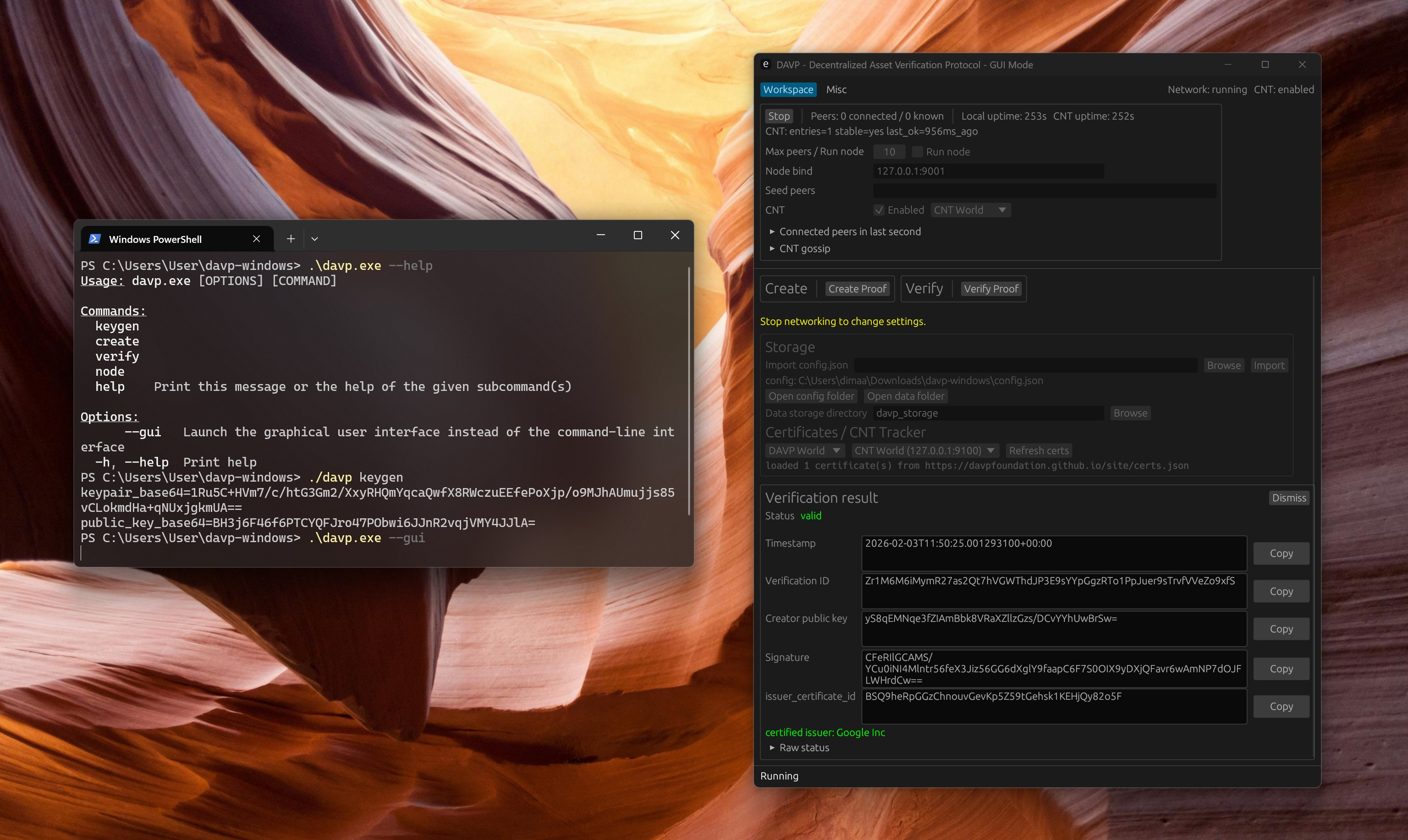
Demo representation of DAVP in GUI mode
- An asset is treated as opaque bytes (typically a file).
- DAVP computes a BLAKE3 hash of the bytes and binds it to metadata and a UTC timestamp.
- The binding is signed with an Ed25519 keypair.
- The resulting proof is stored locally and can be looked up by a 64-character
verification_id.
- Asset hash (BLAKE3)
- Creator public key (Ed25519)
- Timestamp (UTC)
- Asset type and an
ai_assistedflag - Metadata (tags, optional description, optional parent verification id)
- Signature (Ed25519) over a serialized signing payload
The verification_id is a lookup identifier. Authenticity comes from the signature. Asset binding is performed when the verifier provides the asset bytes and the hash check matches.
A proof is cryptographically valid if:
- The Ed25519 signature verifies against the reconstructed signing payload and embedded public key.
- If asset bytes are provided, their BLAKE3 hash matches the hash embedded in the proof.
- No global consensus, ordering, or finality
- No blockchain, mining, or consensus mechanism
- No global immutability guarantees across the network
- No truth claims about metadata or real-world identity of a key
- No global namespace or authority for verification IDs
DAVP avoids global consensus, blockchains, and trusted authorities. It is a simple, local-first protocol for cryptographic proofs.
Optional identity labels that do not affect cryptographic validity. Certificates are fetched off-chain and can be used to associate proofs with known issuers.
Issuer certificates are an optional identity label layer. They do not change what makes a proof cryptographically valid.
- Valid proof: signature verifies (and if asset bytes are provided, hash matches).
- Certified proof: valid proof + issuer certificate validation succeeds for the referenced issuer_certificate_id.
- Uncertified proof: valid proof + no issuer_certificate_id, or certificate validation fails/not found.
Certificates are fetched from https://davpfoundation.github.io/certs.json by default. We will soon migrate to a dedicated repository server
Nodes can replicate proofs over a simple TCP protocol (bincode messages) and gossip peer lists. CNT is a tracker/bootstrap server for peer discovery. Nodes report:
- Their listening address
- Their known peers
- Their currently connected peers
The server stores these reports with a TTL and returns a list of peer entries to help nodes find each other. CNT is discovery-only: it does not sign, certify, or validate proofs, and it has no authority over validity.
CNT is not a trusted authority. It is a hint system only.
- Discovery is not trust. Proof authenticity is verified locally by each node.
- Fake peers are expected. A Sybil attacker can flood CNT with random/unreachable addresses. This does not break proof security; it only wastes connection attempts.
Node behavior:
- Always try connecting to a peer before treating it as usable.
- Drop peers that fail to respond.
- Keep a small local set of peers that actually responded recently.
- Gossip/report only peers that were recently reachable.
CNT hygiene:
- Reports are stored with a short TTL (minutes, configurable).
- CNT rate-limits reports per source IP.
- CNT caps total stored entries to prevent unbounded growth.
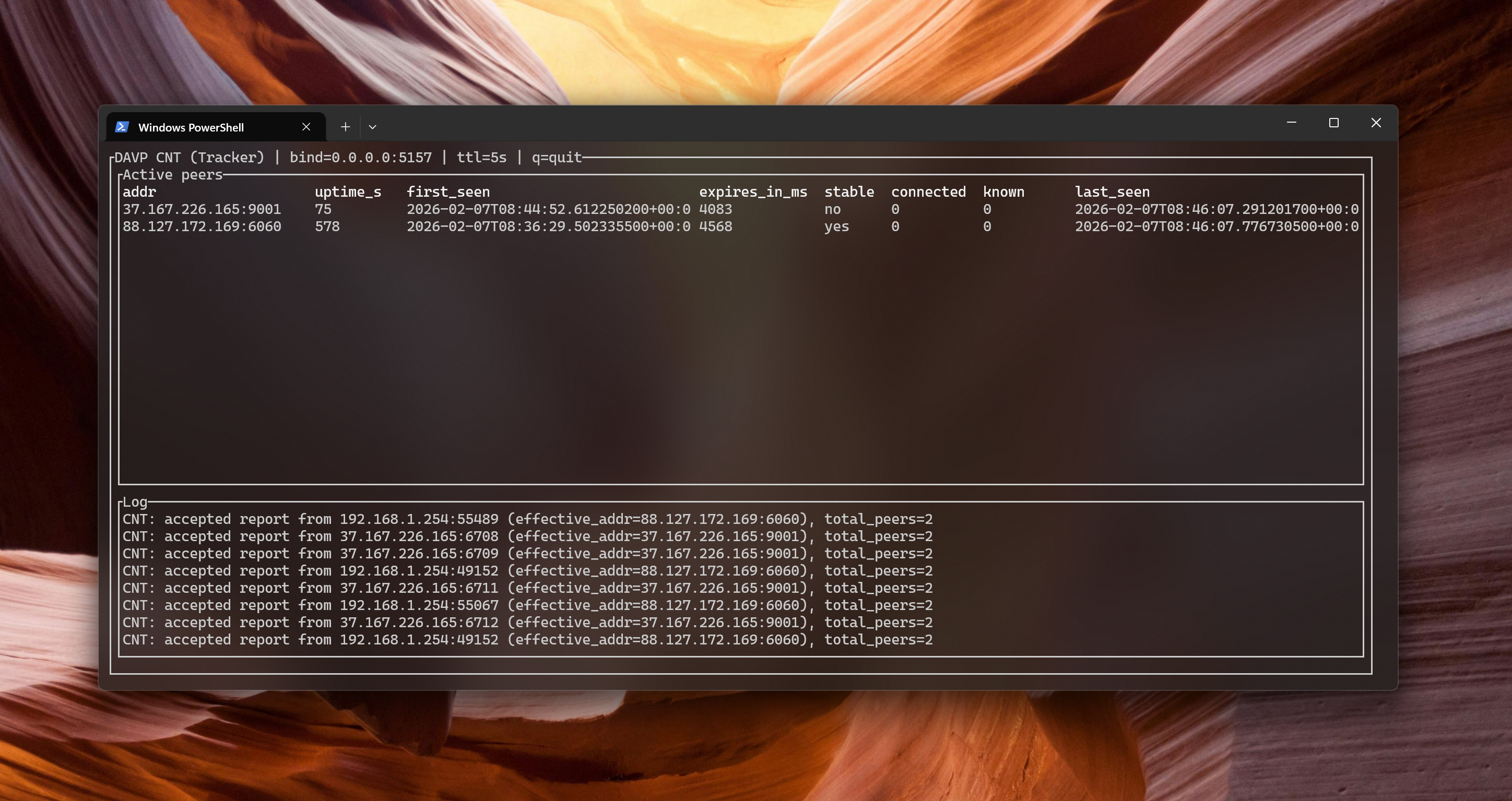
Demo representation of CNT