Quantifying and correcting bias due to outcome dependent self-reported weights in longitudinal study of weight loss interventions
In the past few decades, the increasing rate of obesity has become a worldwide issue, leading to the increasing incidence of several diseases and economic burden. To motivate participants to lose weight and maintain healthy behavior, financial incentive interventions, such as lottery-based and direct payment incentives, are utilized and have been shown to be successful in practice. The objective of this paper is to propose a novel framework of methods to analyze longitudinal self-reported weight loss data and study the effectiveness of financial interventions.
The Keep It Off study, a three-arm randomized controlled trial (RCT) with 189 participants in the analysis cohort, with daily self-reported weights, examined if the participants’ weight loss maintenance can be improved by financial incentives.
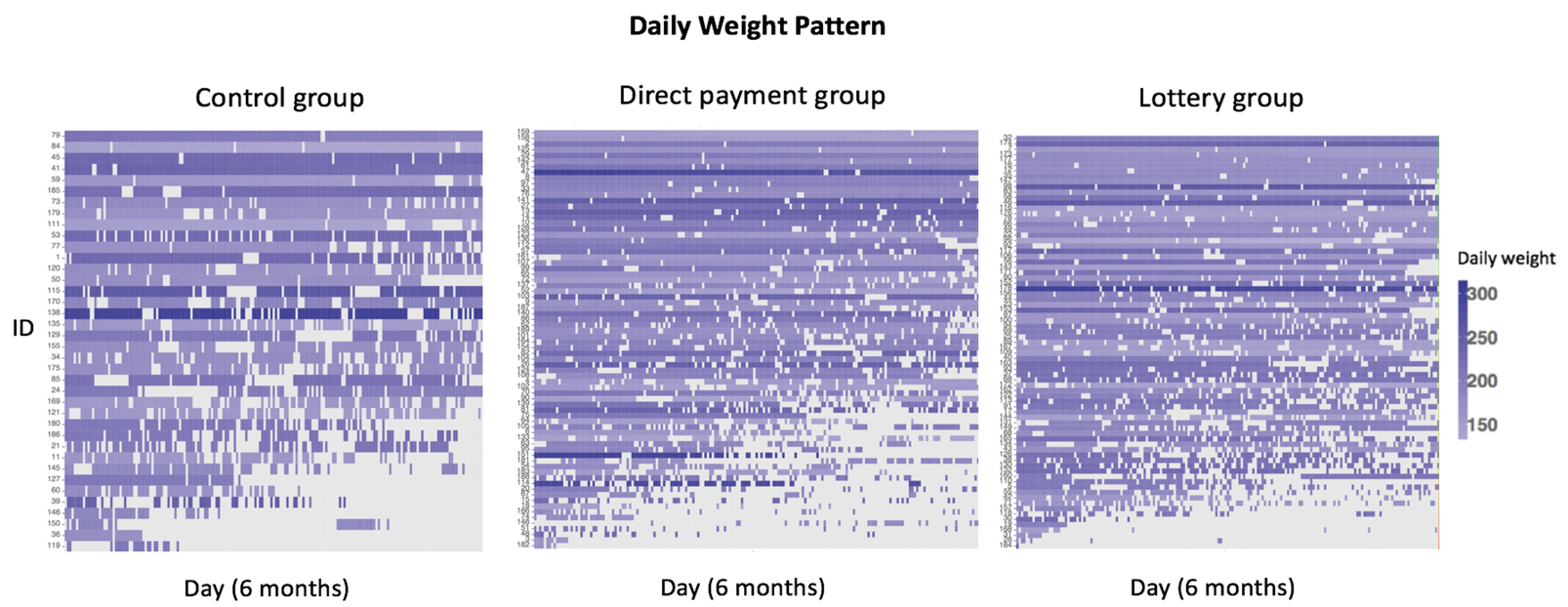
To overcome the challenges due to the informative reporting process in the real-world longitudinal data, we proposed a framework of methods to quantify the evidence of missing not at random due to the outcome-dependent self-reporting mechanism, and to conduct bias correction using estimating equation derived from pairwise composite likelihood.
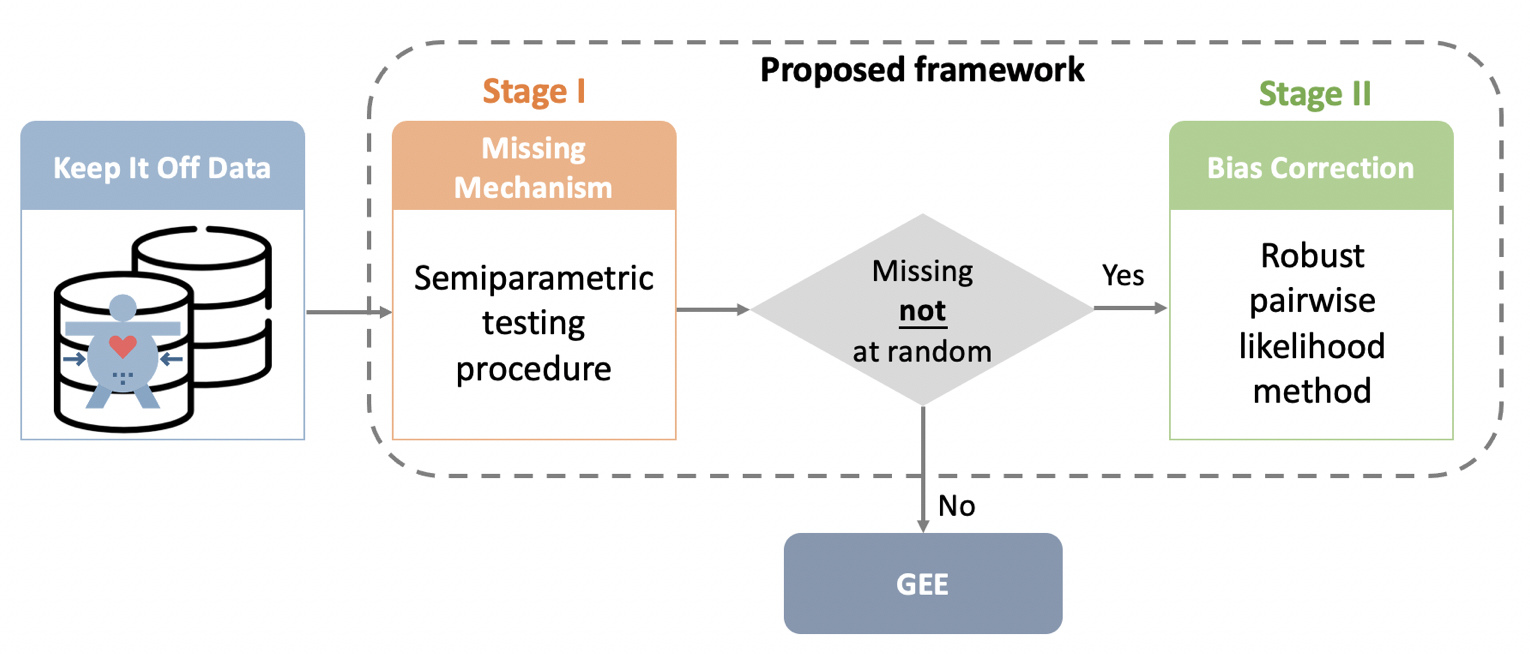
In Stage II, the pairwise construction of likelihood comes with the price of higher computational cost, as the algorithm involves computation of likelihood constructed by all pairs of patients within a site. To alleviate this limitation, we implemented an algorithm with R calling C, which is about 50 times faster than using the R programming language alone. The R code and C code to implement the method can be found in this repo.