


Docs and endpoints are built for humans. Coding agents one-shot the clean, well-documented APIs — and break on the painful ones: long-tail, paywalled, badly-documented, drifting. Wrong auth, wrong units, wrong shape — the call that fails before it ever reaches the endpoint.
Gecko is the comprehension layer. Point an agent at any API's spec and it:
- Finds the right call among hundreds of operations.
- Injects the access the spec doesn't explain — the auth handshake, the scope.
- Makes the call correctly the first time — params, units, idempotency, the exact shape.
- Stays correct when the API drifts — tools are a pure function of the surface; re-comprehend, don't hand-patch.
No integration code. Control-plane only — we store the API surface + the generated tools + correctness metadata, never your payloads, data, or secrets.
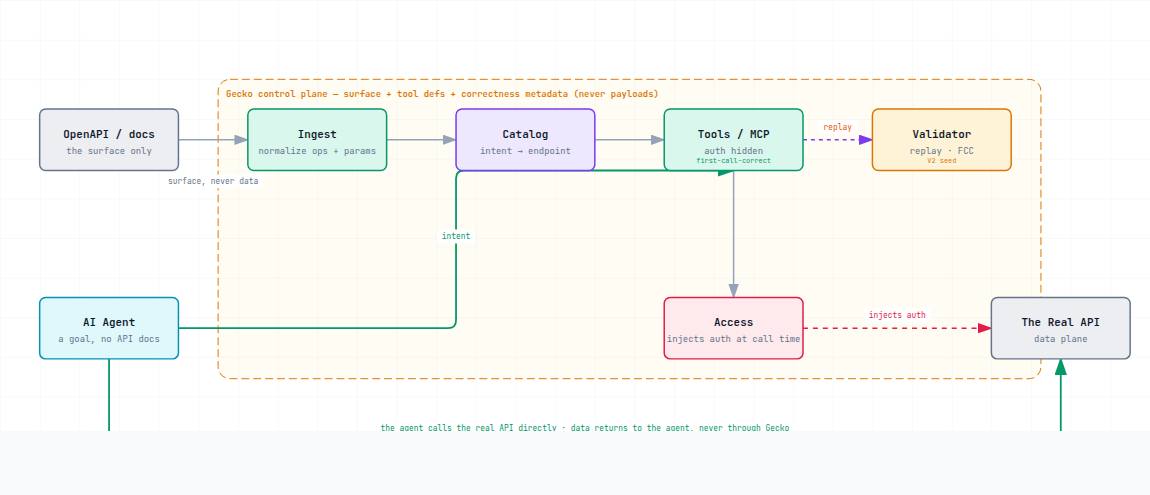
Gecko holds the API's surface, the generated tools, and correctness metadata — never your payloads, keys, or data. Your agent describes intent; Gecko finds the right call and injects auth at call time; then the agent calls the real API directly and the data returns to it, off Gecko's path.
- Ingest — OpenAPI 3.x (or recovered from docs) → normalized operations, surface only.
- Catalog — intent → the right endpoint among hundreds.
- Tools — question-shaped defs; auth headers hidden from the agent.
- Access — one API-agnostic seam injects credentials at call time (BYOK, keys stay on your machine).
- Call — the agent hits the real API directly; Gecko stays off the data plane.
One code path, two modes: recorded synthesizes the response from the schema ($0, offline, falsifiable) and live makes the real call — they differ only at the transport edge.
Marketplaces help agents discover APIs. Payment rails help agents pay for them. Gecko makes agents use them — correctly, first call. We compose on x402, MCP, and pay.sh — we don't replace them.
- gecko-surf — the engine (Apache-2.0, on PyPI). Turns any OpenAPI 3.x into first-call-correct, question-shaped agent tools, served over MCP.
- gecko-docs — the developer docs: quickstart, how it works, and the going-live runbook.
V1 — comprehension — is live on Solana mainnet end-to-end (first-call-correct against a real, paywalled API), with a $0 recorded mode that proves every call offline first. The frontier is multi-API correlations — a spec-derived surface graph that plans the right chain of calls — and comprehension-native anti-poisoning. Consumer willingness-to-pay is the real decider — validating now via discovery. We don't read "a working demo" as "a proven business."
Make any API agent-usable. · geckovision.tech · pip install gecko-surf