



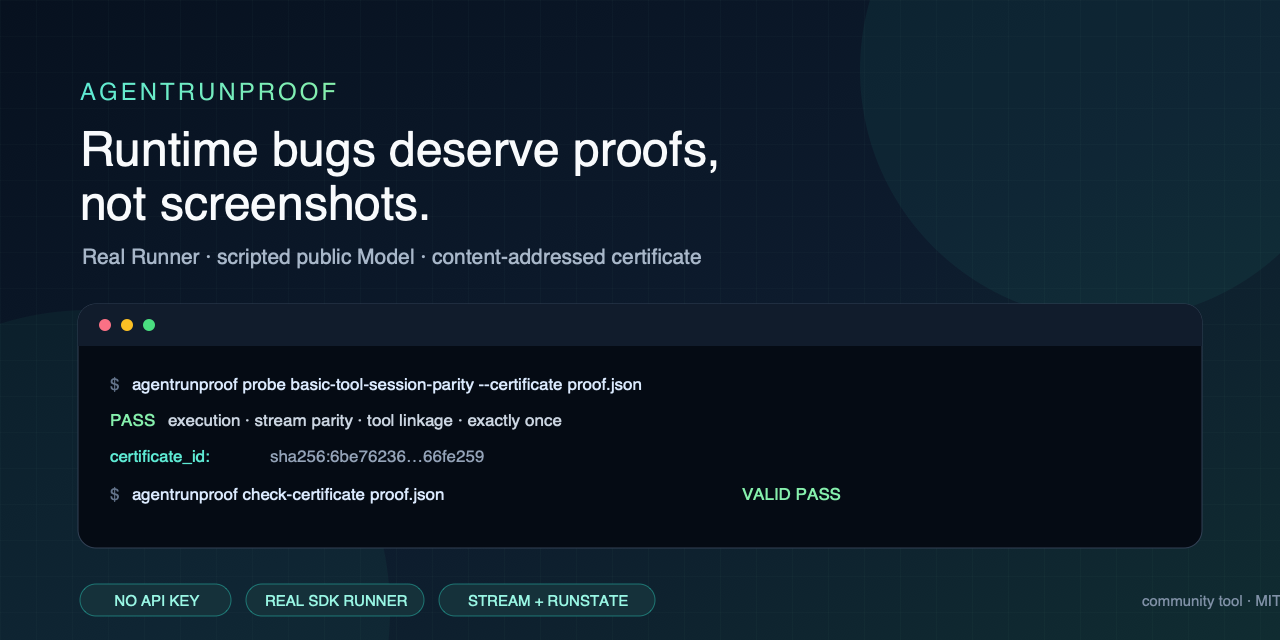
Catch OpenAI Agents SDK Runner regressions without an API key.
AgentRunProof runs deterministic scenarios against the real Runner, compares observable behavior
across run and run_streamed, and writes content-addressed JSON records for stream, session,
tool-linkage, and RunState resume invariants. A failing record carries the normalized
counterexample observations.
AgentRunProof v0.2 declares the openai-agents>=0.20,<0.22 compatibility window on Python
3.10–3.14. Its packaged CI matrix verifies the exact 0.20.0 and 0.21.0 release baselines.
Built-in scenarios make no model API call and require no API key.
AgentRunProof-backed reports are referenced by two merged maintainer fixes, #4413 and #4414. This is upstream diagnostic impact—not OpenAI adoption, dependency, or endorsement.
Read the five-minute RunState case study for the released failure, the recursive follow-up, and the exact before/after evidence chain. For complete usage details, start with the documentation index, Python API reference, or CLI reference.
python -m pip install "agentrunproof==0.2.0"
agentrunproof probe basic-tool-session-parity --certificate proof.json
agentrunproof check-certificate proof.json
Expected output:
PASS basic-tool-session-parity
  PASS    execution_outcome: OK
  PASS    stream_parity: OK
  PASS    tool_linkage: OK
  PASS    exactly_once: OK
  PASS    model_script_consumed: OK
certificate_id: sha256:...
written: proof.json
VALID sha256:... PASS
Exit 0 means PASS, 1 means an observed invariant violation, and 2 means invalid or
unverifiable evidence. See the
provider-free real Runner example
and the
OpenAI Agents integration guide.
Maintaining a downstream library? The
isolated, test-only CI guide
provides a copyable real-Runner contract test and an ephemeral uv matrix for exact SDK 0.20.0
and 0.21.0. It keeps AgentRunProof out of runtime metadata and the project lockfile. Provider-free
means the built-in deterministic model sends no model-provider request; it does not make arbitrary
downstream code or dependency installation network-isolated.
For artifact review, pin agentrunproof==0.2.0 and use the immutable
v0.2.0 release, whose
SHA256SUMS binds the wheel and sdist. The release workflow rebuilds and byte-compares those
artifacts, smoke-tests the wheel, and publishes the same verified files to PyPI through OIDC trusted
publishing. The CI guide records the exact hashes and the remaining third-party-code trust boundary.
Use the SDK's public agents.testing.ScriptedModel with pytest for a focused deterministic
application or SDK test. AgentRunProof delegates to ScriptedModel on SDK 0.21 and adds reusable
scenario orchestration, automatic run/run_streamed comparison, multi-phase RunState checks,
cross-version evidence, and content-addressed records.
| You need to… | Start with |
|---|---|
| Script model responses and assert one application behavior | agents.testing.ScriptedModel + pytest |
| Compare the same contract across runner modes or SDK versions | AgentRunProof |
Check approval/rejection and JSON-restored RunState flows |
AgentRunProof |
| Share a normalized record that can be checked without a provider call | AgentRunProof |
| Evaluate model-output quality | An eval framework, not AgentRunProof |
- declared completion, interruption, or Runner-exception outcomes for every scenario phase;
- post-run parity between non-streaming execution and scripted terminal-event streaming (
response.output_item.doneplusresponse.completed); - ordered function-call/output linkage in generated items,
Sessionsnapshots, and every model input; - declared counts for scenario-owned local tool invocations;
- consumption of each deterministic model script;
- selected public
RunStatetransitions: JSON transport,from_json()reconstruction, restored-state equality, interruption identities, and exact approve/reject decisions; - direct sibling-
RunStateapproval isolation from repeatedRunResult.to_state()calls; - recursive approval routing through two
Agent.as_toolcheckpoints while preserving an untouched direct sibling state; - recursive approval routing after a public
RunState.to_json()/RunState.from_json()boundary, with one exact approval applied to the restored interruption; - per-phase tool-count deltas, scenario probes, and replay of persisted tool history.
The terminal-event profile does not claim token/delta, timing, backpressure, or cancellation-stream equivalence. Generic handoff, retry, cancellation, max-turn, generalized snapshot-isolation, and task-cleanup contracts remain future scenarios unless a certificate explicitly names and observes them.
AgentRunProof checks SDK runtime semantics. It is not a model-quality evaluator, tracing backend, HTTP recorder, hosted service, or general agent framework.
For observability integration tests, DeterministicModel(..., emit_traces=True) emits the SDK's
ordinary generation span while the real Runner emits its agent and tool spans. The default is
False, and run_scenario() still disables tracing. Built-ins remain provider-free, but arbitrary
scenario tools and hooks are not network-sandboxed. Use the opt-in by passing the model directly
to Runner.run() or Runner.run_streamed(); any installed trace processor may export data or make
network requests.
python -m pip install -e ".[test,dev]"
agentrunproof --version
agentrunproof list-scenarios
agentrunproof probe basic-tool-session-parity --certificate build/basic.json
agentrunproof check-certificate build/basic.json
A successful probe exits 0; an observed invariant violation exits 1; invalid input or unverifiable evidence exits 2.
The sibling-isolation probe intentionally exposes a released SDK counterexample:
agentrunproof probe runstate-sibling-approval-isolation \
  --certificate build/runstate-sibling-isolation.json
agentrunproof check-certificate build/runstate-sibling-isolation.json
On openai-agents==0.20.0, approving one sibling state also mutates an untouched sibling; resuming
that untouched state executes the protected tool. The certificate records
state_fork_isolation: SIBLING_STATE_MUTATED and the associated unexpected outcome and side
effect. This adjacent gap was reported on upstream PR
#4409;
the report is not a claim that #4409 introduced the bug.
The recursive routing probe exercises the remaining boundary after upstream #4413:
agentrunproof probe runstate-recursive-agent-tool-approval-routing \
  --certificate build/runstate-recursive-approval.json
agentrunproof check-certificate build/runstate-recursive-approval.json
It pauses a protected effect behind two Agent.as_tool edges, creates two direct sibling states,
approves only one flattened interruption, and resumes both branches. On upstream commit 0b93ce8,
the untouched sibling correctly remains pending but the approved sibling also remains interrupted;
the focused result is
recursive_approval_routing: APPROVED_NESTED_STATE_REMAINED_INTERRUPTED. A corrected runtime must
finish the approved branch with exactly one effect in both runner modes while leaving the untouched
branch at zero effects.
The serialized-routing probe checks the durable form of the same contract:
agentrunproof probe runstate-recursive-agent-tool-approval-serialization \
  --certificate build/runstate-recursive-approval-serialization.json
agentrunproof check-certificate build/runstate-recursive-approval-serialization.json
The initial head of upstream PR #4414 (9dc7da9) fixed the live path but remained interrupted after
JSON restoration. The revised head 1725a898 passes the built-in restored-approval scenario in both
runner modes and was squash-merged as 50d65f65; the upstream 24-case regression also covers
approval and rejection before and after restoration across two and three nested edges. The
immutable v0.1.2 comparison bundle pins the released failure, the intermediate merged behavior,
and the final recursive and serialized PASS results by wheel hash and Git provenance. The v0.2.0
release carries a freshly reproduced bundle for the same causal ladder, bound to the v0.2.0
harness wheel.
For library scenarios, the top-level package exposes Scenario/ScenarioCase for one run and ScenarioPlan/ScenarioPhase/ResumeInput/StateProbe for ordered multi-run contracts, together with DeterministicModel, RecordingSession, run_scenario(), and certificate helpers. The built-in scenario and the two multi-phase historical scenarios are executable examples.
The development matrix uses only released SDK wheels and public runtime interfaces:
| Upstream case | Buggy boundary | Fixed boundary | Required fingerprint |
|---|---|---|---|
| #4322 | 0.19.4 FAIL | 0.20.0 PASS | session limiting must not send an orphan function output to the model |
| #4244 | 0.19.4 FAIL | 0.20.0 PASS | serialized approval must survive a context-overridden resume and execute once |
| #4125 | 0.19.2 streamed FAIL | 0.19.3 PASS | a committed tool call/output pair must survive a resumed output-guardrail tripwire |
Run a local, non-canonical rehearsal with:
python scripts/run_history_matrix.py --output-directory build/history-rehearsal
agentrunproof check-history-matrix build/history-rehearsal/matrix.json
Canonical evidence is stricter: Linux x86_64 CPython 3.12, fresh environments, hash-locked wheel closures, isolated worker processes, a Python socket-deny guard during scenario execution, an exact clean Git commit, and a bundle marker written last. Artifact acquisition occurs before the network guard and is explicitly recorded as a limitation. The immutable v0.1.0 Gate 2 bundle is published under evidence/history/v1.
The 0.19.x rows are historical-only compatibility probes, not supported installations: the harness wheel is installed with --no-deps over each locked legacy SDK closure, and that dependency-metadata bypass is explicit in the canonical bundle.
Certificate and history identifiers are SHA-256 addresses over canonical JSON. The independent checker rejects schema drift, non-finite or duplicate-key JSON, semantic inconsistencies, forged phase transitions, altered historical fingerprints, a missing or tampered required matrix/marker, and internally inconsistent source-state metadata. The referenced wheel is optional beside a local marker and is separately bound by CI or release artifacts.
Checking a record re-evaluates its normalized observations; it does not rerun the SDK, authenticate an untrusted publisher, or prove that the stated command executed. Public claims therefore require the clean source commit plus a visible CI or release anchor.
The private profile prevents raw observed payloads from being serialized, but values still exist in the scenario process. Its deterministic unsalted hashes are correlatable and may be dictionary-guessed for low-entropy values. Arbitrary user-defined tools, hooks, and probes are not sandboxed. Treat private records as local diagnostics and publish only reviewed synthetic evidence.
The exact release gates and exclusions are in the project charter. The execution plan tracks releases, evidence, and external-adoption work.
AgentRunProof received its first maintainer-level citation when OpenAI Agents follow-up #4413 cited the reported checkpoint isolation defect. The next adoption target is reuse of the recursive regression fixture, an optional CI check, or a documentation reference—not a default SDK dependency. A community-tool entry was proposed on the official v0.21 testing-guide PR. The maintainer kept that guide limited to SDK-maintained APIs while explicitly welcoming future reproducible findings backed by the tool. AgentRunProof therefore remains an external project rather than an official SDK listing or dependency.
Found a public-API Runner inconsistency?
Open a scenario request with the
exact SDK version and a minimal reproducer. Want to make it permanent? See the
contribution guide and add
the smallest failing scenario. For usage questions and early contract ideas, use
Discussions.
If AgentRunProof belongs in your regression toolbox, star the repository so other SDK maintainers can find it.
MIT