An online, snapshot-like ‘encyclopedia’ of how it felt to live in Egypt and Tunisia five years after the Arab Spring. The site is the outcome of the research project “In 2016: How it felt to live in the Arab World five years after the ‘Arab Spring’” conducted at the University of Oslo 2015-18.
Like the Arab Spring itself, this site remains a fragment… and it is kept alive by the hope that one day, it may come to fruition!
## Much has been written about democracy (or the lack of it), political Islam and violence in the Middle East after the ‘Arab Spring’. But how do these aspects relate to the realities of everyday life in the post-revolutionary Arab world?
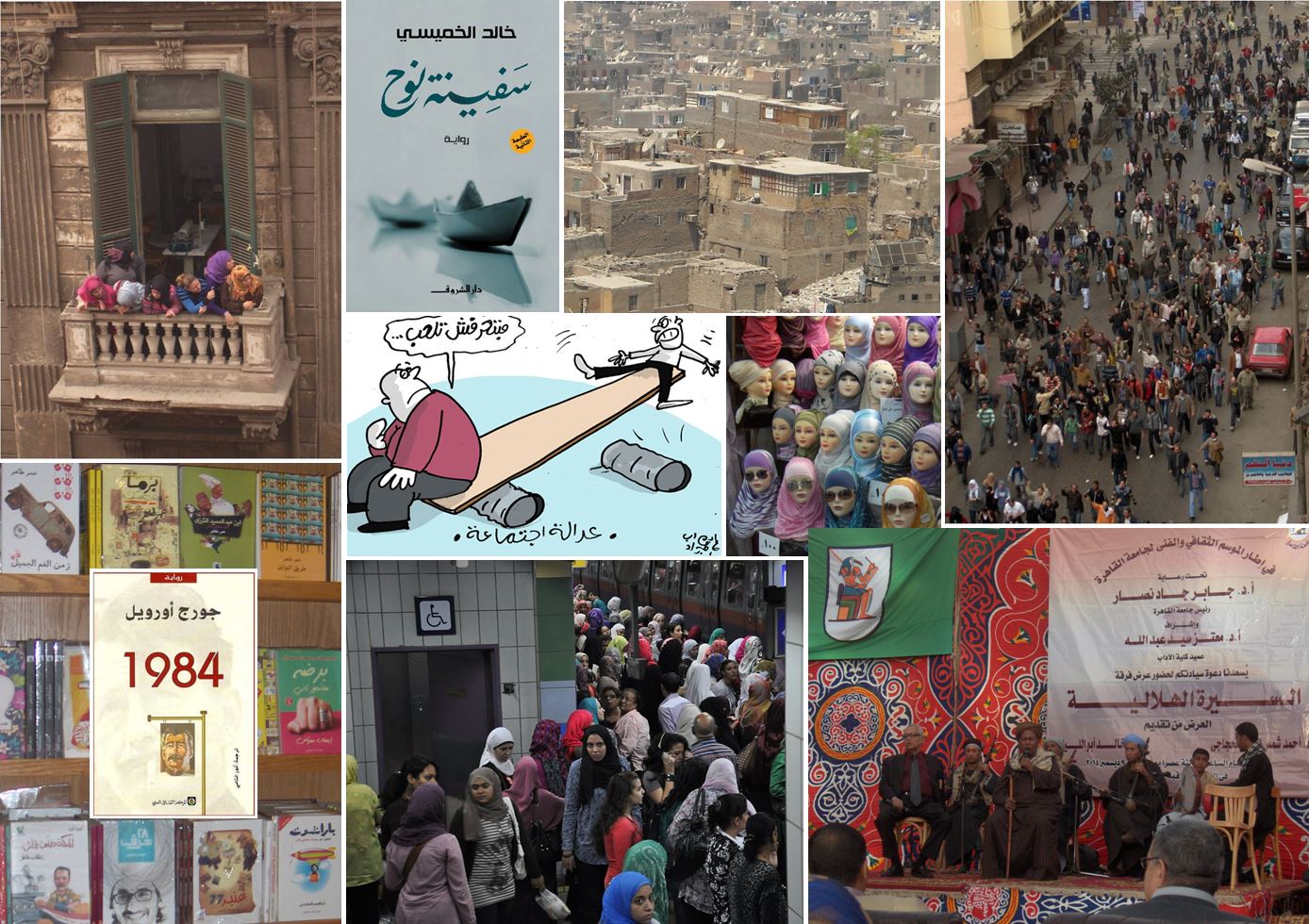


Revolution and post-revolutionary life ► Seamstresses watching on • Noah’s Ark (a novel about emigration) • Housing problems1 • shabâb in the streets • “You're not a good player!” – Social justice (cartoon)2 • hijâb fashion • Side by side: adab sâkhir (satire) and a translation of Orwell’s 1984 • Crowd in the Cairo tube3 • A performance of the Hilâliyya epic — Foto: Stephan Guth (unmarked, collage), 1affordablehousinginstitute.org, 2cairodar.com, 3dailynewsegypt.com (Moh. Omar)
Aren't there many other matters that are much more important to ‘ordinary’ Arabs than the three catchwords of western media coverage; democracy (or the lack of it), political Islam and violence?
The project "In 2016" will provide an ‘encyclopedia of 2016’ that enables users, in a snapshot portrait of one year, to ‘jump right into’ and move around (via cross-references) in post-revolutionary Arab realities; a tool that allows readers to approximate the experience of ‘how it feels’ to live in the Arab World in this period of transition and historic change.
“Bread”, “freedom”, “social justice”, and “human dignity” were the lead slogans of the uprisings. But these are only the chief rallying cries for a myriad of human concerns and daily life experiences that make up the worlds in which Arabs live today: youth unemployment, unaffordable housing, health, education; traffic jams, overcrowded public transport, almost unbearable pollution, electricity and water cuts; news and rumours and politicking; falling in love, getting married, having children; the question of leaving the country; sexual harassment and rape; but also aesthetic surgery, soap operas, movie and music stars, football, Facebook, film festivals, folklore revival, poetry recitals, the emergence of comic books and graphic novels, or a boom of satire.
And there is also an almost incredible continuity in the life of what is often called ‘the silent majority’ - as if the revolutions had been the fancy idea of a spoiled elite of bourgeois youth.
The project took its methodological inspiration from H.U. Gumbrecht’s seminal study "In 1926: Living at the Edge of Time", applying the latter’s one-year snapshot approach to Arab lifeworlds of 2016.
The project focused on two key fields of cultural production where topical issues and ‘the meaning of life’ are regularly discussed and from where reflections of bodily experiences, emotions and affects can be collected: fiction and social media.
The main objective was to identify the dispositifs that characterized Egyptians’ and/or Tunisians’ way of experiencing and categorizing their realities and the alternative choices that would inform decisions in life and the ways of looking at things. An online researchers' notebook accompanies and supplements the analysis and interpretation of literary texts and online postings.
- The ‘encyclopedia of 2016’ (prepared for the main part by a postdoctoral researcher in literature/film studies),
- A doctoral dissertation on Arabic social media
- Several articles by the main participants
- Two workshops (2016, 2018) and a larger conference (2017) that gathered international expertise to discuss post-revolutionary Arab realities
- An online researchers’ notebook that will help to identify key concepts and structures Arabs use to make sense of life in a post-revolutionary world.
-
Guth, Stephan; Hofheinz, Albrecht & Chiti, Elena (2018). In 2016 -- How it felt to live in the Arab World five years after the "Arab Spring".Show summary
-
Guth, Stephan; Hofheinz, Albrecht & Haugen, Toril Kristin Viken (2017). Lagar "leksikon" over året 2016: Livet i Egypt og Tunisia fem år etter. [Journal]. Apollon.
-
Chiti, Elena (2017). Rendez-vous de l’Histoire du Monde Arabe.
-
Mohamed, Mohab Attia Mahmoud (2017). The use of visual techniques in communicating meanings in YouTube activism.
-
Chiti, Elena (2017). Due storie per una città? Dal Museo greco-romano (1892) al Museo Nazionale di Alessandria d’Egitto (2003).
-
Mohamed, Mohab Attia Mahmoud (2017). Living together in a patriarchal context – codes of coexistence.
-
Hofheinz, Albrecht (2017). Baby Milk.
-
Guth, Stephan (2017). Die zum Islam konvertierte Jüdin – Zur Rolle eines Wunschbilds in nahöstlichen Gesellschaften nach dem 'Arabischen Frühling'.Show summary
-
Guth, Stephan & Chiti, Elena (2016). Living 2016: Cultural Codes and Arrays in Arab Everyday Worlds Five Years After the “Arab Spring” = Proceedings of a workshop, held at the Department for Cultural Studies and Oriental Languages (IKOS), University of Oslo, Norway, May 29-30, 2016. Journal of Arabic and Islamic studies. ISSN 0806-198X. 16, p. 221–388. doi: 10.5617/jais.4761.
-
Chiti, Elena (2016). The Crisis as an Institutional Tool? Challenging Anti-Institutional Challenges in the Egyptian Cultural Field.
-
Guth, Stephan (2016). An Egyptian utopia and "In 2016" : project presentation and a first attempt at an analysis.
-
Guth, Stephan (2016). In 2016 - How it feels to live in the Arab world five years after the "Arab Spring": Introduction and presentation of a research project at UiO.
-
Mohamed, Mohab Attia Mahmoud (2016). Digital reality as heterotopia: Exploring the relation between daily life discourse and online activity in Egyptian culture.
-
Hofheinz, Albrecht (2016). Social Media Five Years after the “Arab Spring”—Some General Remarks.
-
Chiti, Elena (2016). "Lack of collective resources = individual resourcefulness (ibtikar): an Egyptian broken code?".
-
Chiti, Elena (2016). "Ink and blood: crime and popular culture in 2016 Egypt".
-
Guth, Stephan (2016). Arabic Fiction Five Years After the "Arab Spring" - Some general remarks.
-
Hofheinz, Albrecht (2016). A Look Back on Generation Stuck: of Dreams Repressed, of Seeking a Way Out.
-
Mohamed, Mohab Attia Mahmoud (2016). The parallel media: Comments on political and social life on YouTube channels.
-
Guth, Stephan (2015). A close reading of Hans Ulrich Gumbrecht's "In 1926".
-
Guth, Stephan (2015). "In 2016 - How it feels to live in the Arab World five years after the 'Arab Spring'" -- Presentation of the NFR-funded research project.
-
Mohamed, Mohab Attia Mahmoud (2015). presentation of PhD project.
-
Hofheinz, Albrecht (2015). Withdrawal from Taḥrīr? Voices from the social media on the fate of the revolution, the wall of fear, and the role of individual actors in post-coup Egypt. Universitetet i Oslo.Show summary
Original: https://www.hf.uio.no/ikos/english/research/projects/in_2016/