 Euphony
UTF-8 클래스 만들기 #81

Replies: 7 comments 31 replies

-
|
UTF-8 well-formed byte seqences 입니다. 코드 포인터 범위마다 유효한 바이트값의 범위를 확인할 수 있습니다! Table
Reference: https://stackoverflow.com/questions/1301402/example-invalid-utf8-string |
Beta Was this translation helpful? Give feedback.

-
|
유효성 검사 좋아요!! |
Beta Was this translation helpful? Give feedback.

-
|
유용한 Table 감사합니다!! :) |
Beta Was this translation helpful? Give feedback.

-
|
테이블 오류 수정 |
Beta Was this translation helpful? Give feedback.

-
|
고생하셨습니다!! |
Beta Was this translation helpful? Give feedback.

-
|
@kuro11pow2 @judemin
한글은 3Bytes, 영어는 1Bytes이므로 hexSource의 size는 12인데, 이를 decode할 때, 어디서 끊어야할지(?) 어떻게 구분할 수 있을까요? 저는 위 같이 이해하고 있었는데, 제가 잘 못 이해하고 있는 점이 있다면 피드백 바랍니다!!! |
Beta Was this translation helpful? Give feedback.
-
|
첫번째 바이트의 범위로 구분 할 수 있습니다! 바로 위의 코멘트를 보시면 1~4바이트로 표현되는 코드 포인트 구간들은
예를들어 말씀하신 '가'를 encoding하면 eab080이 되고, First Byte인 ea가 E0 - EF 의 범위안에 있으므로 3바이트가 한 묶음인 것을 알 수 있습니다. 따라서 ea b0 80 까지를 한 묶음으로 봅니다. |
Beta Was this translation helpful? Give feedback.
-
|
그 부분을 고려하면 되겠군요!! 친절한 답변 감사합니다 :) |
Beta Was this translation helpful? Give feedback.

-
|
로직을 어떻게 구현할지 함께 고민해봐요! EncodeHexVector encode(std::string src); 입력"가" = eab080 = 111010101011000010000000 출력1110 1010 1011 0000 1000 0000 |
Beta Was this translation helpful? Give feedback.
-
|
그냥 캐릭터 한 개씩 잘라서 HexVector에 pushBack하면 8bit 짜리가 알아서 4bit씩 두 번 push 됩니다 HexVector UTF8Charset::encode(std::string src){
HexVector result = HexVector(src.size());
for(int i = 0;i < src.size();i++)
result.pushBack(src[i]);
return result;
} |
Beta Was this translation helpful? Give feedback.
-
|
넵 감사합니다! |
Beta Was this translation helpful? Give feedback.
-
|
설명 감사드립니다:) |
Beta Was this translation helpful? Give feedback.
-
Decodestd::string decode(const HexVector &src);입력1110 1010 1011 0000 1000 0000 출력"가" = eab080 = 111010101011000010000000 |
Beta Was this translation helpful? Give feedback.
-
|
HexVector의 hexSource에는 4bit 단위로 데이터가 저장되니까 hexSource의 2개를 한 덩어리로 만들어서 string에 더하면 되지 않을까요? 예를 들어 이렇게 1바이트 char 가 되니까요! |
Beta Was this translation helpful? Give feedback.
-
|
넵 스트림을 이용하는 방법은 애초에 스트림에 넣을 수 있는 길이의 한계 때문에 지금 저희가 하는 방향처럼 직접적으로 비트를 다루면서 해야 할 것 같습니다! |
Beta Was this translation helpful? Give feedback.

-
|
스트림은 그런 한계가 있군요,,,!! |
Beta Was this translation helpful? Give feedback.

-
|
현재 제 컴퓨터에서 개발 환경이 세팅되어 있지 않아서 #include<iostream>
#include<vector>
#include<string>
#include <stdint.h>
#include <sstream>
using namespace std;
void binary(unsigned int tmp) {
int arr[8];
int cnt = 0;
while (cnt != 8) {
arr[cnt] = tmp % 2;
tmp /= 2;
cnt++;
}
for (int i = 7; i >= 0; i--) {
if (i == 3)
cout << " ";
cout << arr[i];
}
cout << "\n";
}
int main() {
string s1 = "가나abc";
string s2;
cout << "Full String : " << s1 << endl;
for (int i = 0; i < s1.size();i++) {
unsigned int nowHex = unsigned int(s1[i]);
cout << hex << nowHex << " ";
binary(nowHex);
}
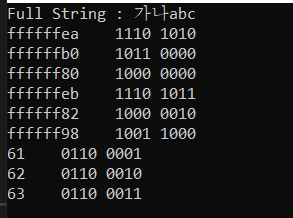
}현재까지 작성한 테스트 코드는 위와 같으며 string을 hex로 변환해 첫 8비트를 이진수로 추출해내는 코드까지 작성하였습니다. 여기서 각 char의 첫 8비트 내 첫 3비트를 보고 이후의 char의 길이를 유추하여 하나의 긴 hex 값이나 string으로 합쳐서 각 단어를 추출하는 방법을 생각하고 있습니다. |
Beta Was this translation helpful? Give feedback.
-
|
수고 많으셨습니다 ㅎㅎ. |
Beta Was this translation helpful? Give feedback.
-
|
|
Beta Was this translation helpful? Give feedback.
-
|
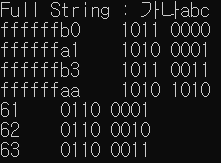
해결했습니다! 설정 오류였네요ㅎㅎ.. |
Beta Was this translation helpful? Give feedback.
-
|
앗 넵!! 고생 많으셨습니다! |
Beta Was this translation helpful? Give feedback.
-
|
넵!! 👍 |
Beta Was this translation helpful? Give feedback.
-
#include <iostream>
#include <vector>
#include <string>
#include <sstream>

using namespace std;
typedef uint8_t u_int8_t;
using namespace std;
class HexVector {
public:
    HexVector(int size) {
        hexSource.reserve(size);
    }

    void pushBack(u_int8_t hexByte) {
        if (hexByte <= 0x0f)
        {
            hexSource.push_back(hexByte);
        }
        else
        {
            hexSource.push_back((hexByte >> 4));
            hexSource.push_back(hexByte & 0x0f);
        }
    }

    const std::vector<u_int8_t>& getHexSource() const {
        return hexSource;
    }

private:
    std::vector<u_int8_t> hexSource;
};

class Charset {
public:
    virtual ~Charset() = default;

    virtual HexVector encode(std::string src) = 0;
    virtual std::string decode(const HexVector& src) = 0;
};

class UTF8Charset : public Charset {
public:
    UTF8Charset() = default;
    ~UTF8Charset() = default;

    HexVector encode(std::string src) {
        HexVector result = HexVector(src.size());

        for (int i = 0; i < src.size(); i++)
            result.pushBack(src[i]);

        return result;
    }

    std::string decode(const HexVector& src) {
        std::string result;
        std::vector<u_int8_t> a = src.getHexSource();
        int char_byte = 0;
        int start_index = 0;
        int start_byte;

        while (start_index < a.size() - 1) {
            std::string c = "";
            int start_byte = (a[start_index] << 4) | a[start_index + 1];
            if ((start_byte & 0b11111000) == 0b11110000) {
                char_byte = 4;
            }
            else if ((start_byte & 0b11110000) == 0b11100000) {
                char_byte = 3;
            }
            else if ((start_byte & 0b11100000) == 0b11000000) {
                char_byte = 2;
            }
            else if ((start_byte & 0b10000000) == 0b00000000) {
                char_byte = 1;
            }
            int next_index = char_byte;
            int i = start_index;
            while (char_byte != 0) {
                c += ((a[i] << 4) | a[i + 1]);
                i += 2;
                char_byte--;
            }
            start_index += next_index * 2;
            result += c;
        }
        return result;
        /* for test
        std::cout << hex << ((a[0] << 4) | a[1]);
        cout << hex << (a[2] << 4 | a[3]);
        cout << hex << (a[4] << 4 | a[5]);
        result += a[0] << 4 | a[1];
        result += a[2] << 4 | a[3];
        result += a[4] << 4 | a[5];
        cout << endl;*/
    }
};

int main() {
    UTF8Charset a;
    UTF8Charset b;
    HexVector c = a.encode("!@#가나다라12345abdcd^&^$");
    std::cout << "예상 결과 : !@#가나다라12345abdcd^&^$" << endl <<  b.decode(c);
} |
Beta Was this translation helpful? Give feedback.
-
|
오호 잘 돌아간다니 다행입니다👍👍 |
Beta Was this translation helpful? Give feedback.
-
|
@aiclaudev @judemin ex) euphony/src/main/cpp/core/UTF8Charset.h #ifndef EUPHONY_UTF8CHARSET_H
#define EUPHONY_UTF8CHARSET_H
#include "Charset.h"
namespace Euphony {
class UTF8Charset : public Charset {
public:
UTF8Charset() = default;
~UTF8Charset() = default;
HexVector encode(std::string src);
std::string decode(const HexVector &src);
};
}euphony/src/main/cpp/core/source/UTF8Charset.cpp #include "UTF8Charset.h"
#include <bitset>
#include <codecvt>
#include <iomanip>
#include <iostream>
#include <sstream>
#include <string>
using namespace Euphony;
HexVector UTF8Charset::encode(std::string src) {
HexVector result = HexVector(src.size());
for (int i = 0; i < src.size(); i++)
result.pushBack(src[i]);
return result;
}
std::string UTF8Charset::decode(const HexVector& src) {
std::string result;
std::vector<u_int8_t> hexSource = src.getHexSource();
for (int i = 0; i < hexSource.size() / 2; i++)
result += (hexSource[2 * i] << 4) | hexSource[2 * i + 1];
return result;
}
#endif //EUPHONY_UTF8CHARSET_Heuphony/src/main/cpp/tests/utf8CharsetTest.cpp #include <Definitions.h>
#include <UTF8Charset.h>
#include <gtest/gtest.h>
#include <tuple>
using namespace Euphony;
typedef std::tuple<std::string, std::string> TestParamType;
class UTF8CharsetTestFixture : public ::testing::TestWithParam<TestParamType> {
public:
void openCharset() {
EXPECT_EQ(charset, nullptr);
charset = new UTF8Charset();
ASSERT_NE(charset, nullptr);
}
Charset *charset = nullptr;
};
TEST_P(UTF8CharsetTestFixture, EncodingTest) {
openCharset();
std::string source;
std::string expectedResult;
std::tie(source, expectedResult) = GetParam();
HexVector actualResult = charset->encode(source);
EXPECT_EQ(actualResult.toString(), expectedResult);
}
TEST_P(UTF8CharsetTestFixture, DecodingTest) {
openCharset();
std::string source;
std::string expectedResult;
std::tie(expectedResult, source) = GetParam();
HexVector hv = HexVector(source);
std::string actualResult = charset->decode(hv);
EXPECT_EQ(actualResult, expectedResult);
}
INSTANTIATE_TEST_CASE_P(
ChrasetDecodingTestSuite,
UTF8CharsetTestFixture,
::testing::Values(
TestParamType("a", "61"),
TestParamType("b", "62"),
TestParamType("가", "eab080"),
TestParamType("각", "eab081"),
TestParamType("나", "eb8298"),
TestParamType("홍길동", "ed998deab8b8eb8f99"),
TestParamType("@XYZ", "4058595a"),
TestParamType(".com", "2e636f6d"),
TestParamType("서울특별시", "ec849cec9ab8ed8ab9ebb384ec8b9c"),
TestParamType("010-1234-5678", "3031302d313233342d35363738"),
TestParamType("36.5℃", "33362e35e28483")
)); |
Beta Was this translation helpful? Give feedback.
-
|
고생많으셨습니다!!! |
Beta Was this translation helpful? Give feedback.
-
|
정리까지... 감사합니다!! |
Beta Was this translation helpful? Give feedback.
-
|
고생하셨습니다!! |
Beta Was this translation helpful? Give feedback.

-
|
오잉? 생각보다 환경 구축이 안되신 분들이 많네요!? |
Beta Was this translation helpful? Give feedback.
-
|
윈도우 환경에서 GCC가 아닌 컴파일러를 쓰셔서 |
Beta Was this translation helpful? Give feedback.

-
|
아 여기서의 환경 구축은 code로 환경 구축을 의미하는 거죠? ㅎㅎ |
Beta Was this translation helpful? Give feedback.
-
|
넵 맞습니다 ㅎㅎ |
Beta Was this translation helpful? Give feedback.
-
|
넵 안드로이드 스튜디오는 잘 됩니다 ㅎㅎ! |
Beta Was this translation helpful? Give feedback.
-
|
넵 안드로이드 스튜디오는 구축되어 있습니다! |
Beta Was this translation helpful? Give feedback.


Uh oh!
There was an error while loading. Please reload this page.
Uh oh!
There was an error while loading. Please reload this page.
-
21-10-02 12:00 ~ 14:00 결과물
kuro11pow2@c5b10f7
UTF8Charset.h
Beta Was this translation helpful? Give feedback.
All reactions