| marp | true |
|---|---|
| title | Application Caching |
| description | Application Caching Presenation on Markdown |
| theme | gaia |
| size | 58140 |
| paginate | true |
| _paginate | false |
| header | ©️ OSS |
| footer | PaaC Rocks 💙 |

Application Caching Presentation Using Markdown
<style scoped>a { color: #eee; }</style>
- Introduction
- Summary - The What
- Features - What All
- The How
- The Why -> Pros and Cons
- The When and where
- Another How (to Get Started)
- References (From Where)
-
Enable app layer in memory caching which can be used by any API / frameworks to cache data, and improve latency and load on DB
-
Integrate distributed embedded caching with our existing application with simple annotation in our spring applications
- Easily integrate with JPA/Hibernate
- Support for Relational DB / Joins
- Support for TTL
- Support for Cache - Aside strategy
- Light weight and fits into small - pods
- Minimal setup needed / Easy to use - learn
- Distributed Caching - ideal case without a dedicated server
There are two patterns of caching the data in application caching.
- This is the most commonly used caching pattern. Whenever you query your database, your store the result dataset in the cache. Each result dataset will have a hashed version of the query as the cache key.
- Every time you run the query, you first check if cache-key is already in the cache.
- If it’s in the cache return it from there otherwise fetch the result from the database and store the result dataset in the cache for future queries.
- The main issue with this pattern is the cache invalidation. It is hard to invalidate the cached result when you cache a complex query result. When one piece of data changes (for example, a table row) we need to invalidate all cached queries which include that row.
- In objects caching pattern, you store the data as an object as you do in your application code (classes, instances, etc.).
- Your class can assemble a dataset from your database and then you can store the instance of the class or the assembled dataset in the cache.
- Some examples of objects that can be cached are User Sessions, Fully Rendered Web pages, Activity Streams, User Graph Data.
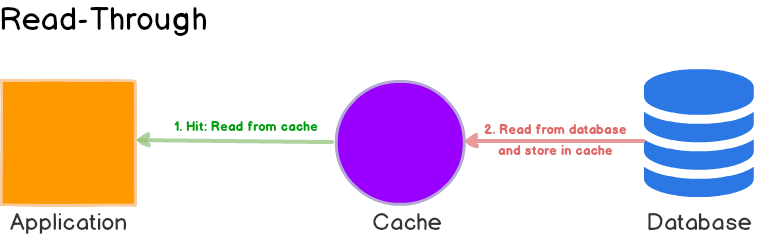
- Read-Through
- In cache-aside, the application is responsible for fetching data from the data store and populating the cache. In read-through, this logic is usually supported by the library or stand-alone cache provider.
- Unlike cache-aside, the data model in the read-through cache cannot be different than that of the database.
- Read-through cache also works best for read-heavy workloads.
- Read-through cache strategy is quite similar to cache-aside accept instead of managing both data store and the cache, delegates data store synchronization to the cache provider
- Both cache-aside and read-through loads data lazily on the first read.

Created by Dean Jain (@dean.jain)
Powered by PaaC (Presentation as a Code) ❤️💜💚💙